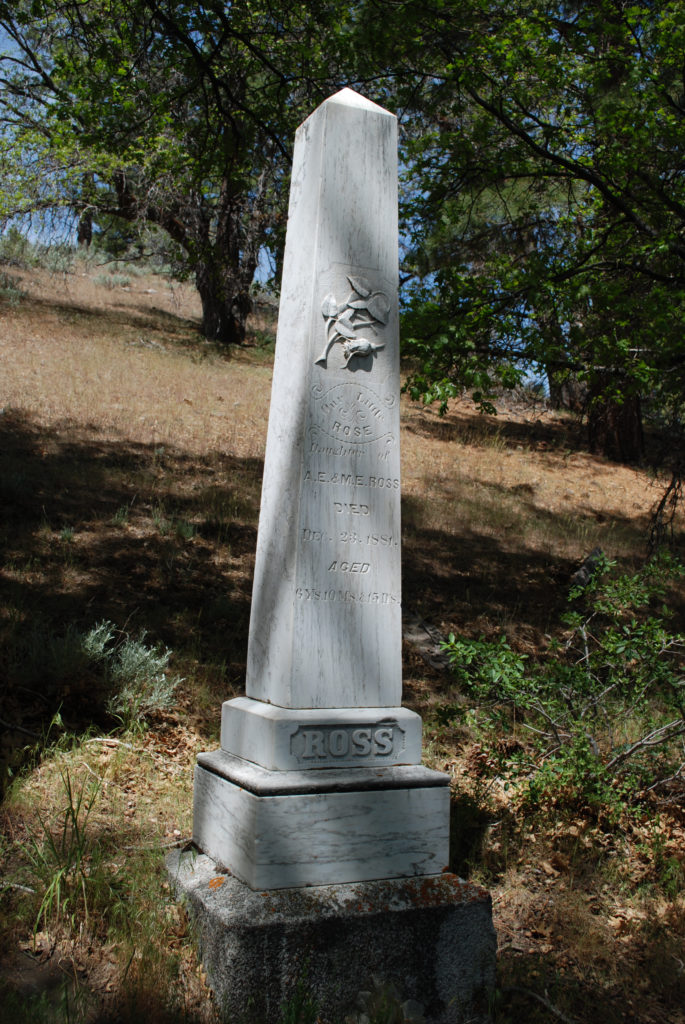
Rosie Ross’ grave, 2008. Courtesy of Lawrence Meeker
For many Christmas a special time year to spread happiness and joy. Yet, for some the Christmas cheer is not. Usually, but not always, a tragic event has happened, and a family member passed away during the holidays.
This happened to Long Valley residents. Albert and Mary Ross. On December 23, 1881, they lost six year old daughter, Rosie Arrowsmith Ross. Her death announcement included the following statement: “Rosie the bright flower of the flock is gone. She died of the dread disease typhoid pneumonia. She was buried near her home on Christmas day, in a shady nook of oak trees overlooking the valley, where a mother’s hand will care for it. Many kind friends assisted and attended the funeral.”
It should be noted that Ross Ranch would later became known Constantia.
Christmas, 1917, in the Swain home, better known today as the Susanville Elks Lodge. Pictured are the Swain Children: Fitzhugh, Nellie, Blanche and Frances. Courtesy of Frances Swain
It is a rarity, or at unless its just me, to locate early day Christmas photographs. In 1906, J. Henry Swain who had a desert homestead at Dry Valley, located between Grasshopper and the Madeline Plains, moved to Susanville and opened at Swain’s Bar. He was astonished that the saloon business was of lucrative. His wife, Annie, was staunch tee-totolar and was not thrilled about her husband’s new occupation. On the other, she did admit about a trade off, since she could indulge in the finer things life. In 1908, Swains purchased dilapidated building at the west end of Main Street. Once renovation process was complete, it was an envy to many. In 1922, the widow Annie Swain sold to the Antlers Club, precursor to the Elks.
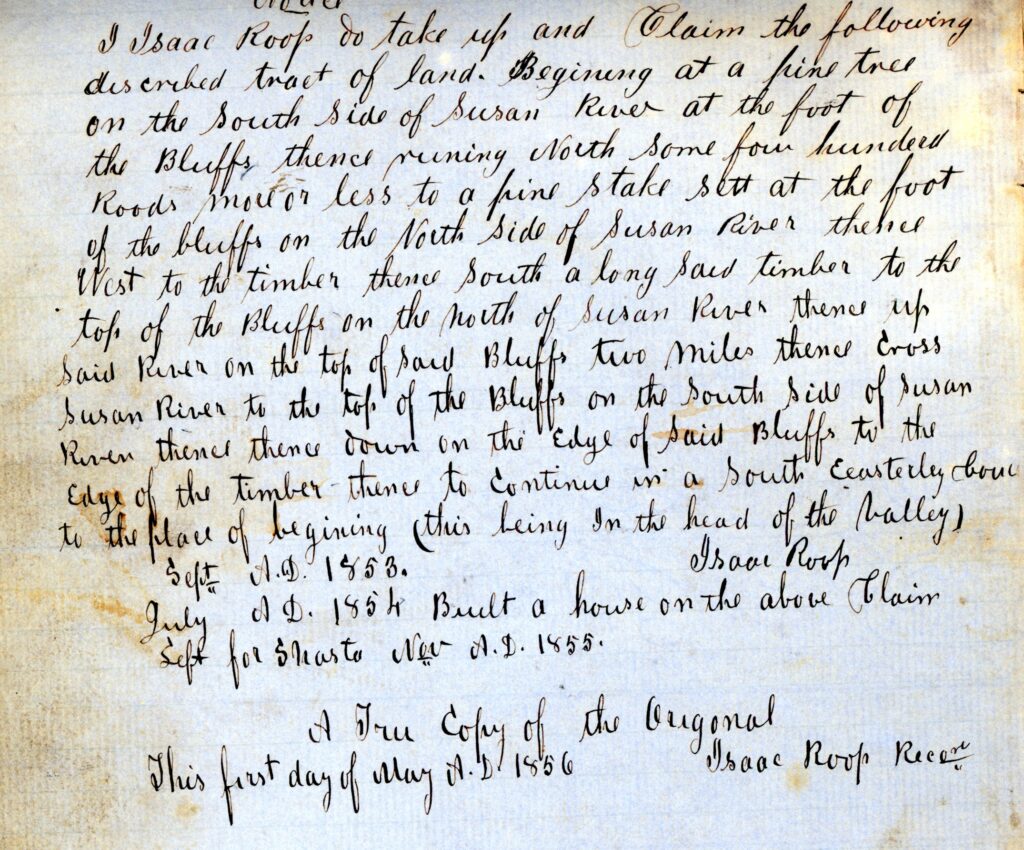
Isaac Roop’s land claim, the first entry in the register.
It is nearing the end of year, so I can wrap up dumpster diving tales. This is a peculiar tale. In the late 1970s and early 1980s the Lassen County Clerk’s Office was discarding historic records left and right. While I expressed my displeasure to the powers to be, it was a fruitless effort. Instead of being confrontal, I was passive. It worked wonders. By the early 1980s, that office have discarded over 70% of its archives dating back to 1864, but I was able to salvage most of them.
In 1912, Susan Roop Arnold donated her father’s land register to the County Clerk for safe keeping. Isaac Roop’s Land Register is the oldest document of the area, where individual in 1855 began to file their land claim. The book had been tucked away in a drawer and ignored. In fact, no one knew in the office, of its historical significance. For over forty years I have been the custodian this register. Ultimately, much of my archives, this included, its future home will be lodged at Special Collections, University of Nevada, Reno, there being no safe and secure facility in Susanville.
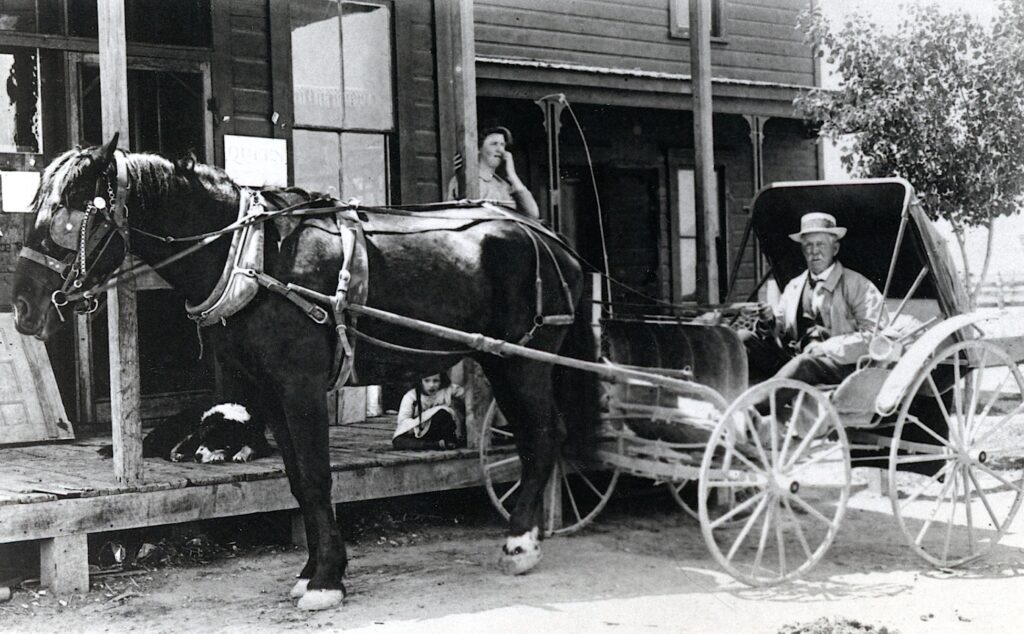
Ben Leavitt in his buggy in front Vic Perry’s store Standish, circa 1908. Leavitt was one of the first settlers Buggytown–Betty Barry Deal
Note: This post originally appeared 22 February 2023. At that I time I used the 1889 photograph of the Buggytown Ditch, because I misfiled the above buggy photograph.
No doubt you never heard of it. It was not named for pesky insects or pushy people either. An irrigation ditch was named as such, too. Buggytown, in its unique way was not even a town, but more like a sprawling affluent neighborhood in the late 1800s, located to the west of Leavitt Lake.It was so named as one of the first settlers possessed a buggy when such luxuries were rare on the frontier. It would later become known as Clinton, which consisted of a store, post office and the Riverside School. In 1973, it was transformed when the first phase of the Leavitt Lake Subdivision began.
Survey crew to enlarge the Buggytown ditch near Johnstonville, 1889. Courtesy of Betty Barry Deal
Note: The Monticola Club is very special to me. One of their earliest endeavors was the formation of the Lassen County Free Library. That library system opened a whole new world when I was growing up, and provided a foundation for my early historical research. Tim
Clean out your closets of extra unused shoes to make room for new shoes/slippers/boots that may be coming your way for Christmas. Monticola Club’s Fundraiser Project is nearing the end and more shoes are needed. In addition to the drop-off locations listed below, there is a large box at Susanville Supermarket.
In essence this is one of those instances where history repeats itself. During the 1850s, Congress passed several bills for a transcontinental railroad and wagon road to connect California to the Union. Numerous routes were surveyed, though most ended at California’s eastern border, with the assumption the State of California would decide the best route. The Honey Lake-Fredonyer-Deer Creek route was deemed one the best, since there was no high elevation summits to cross, thereby reducing the problems associated with winter, i.e., Donner. In 1859, with the discovery of the Comstock Lode in Nevada was a game changer. Politics and the influence of money the Donner Pass route was selected, a costly one at that.
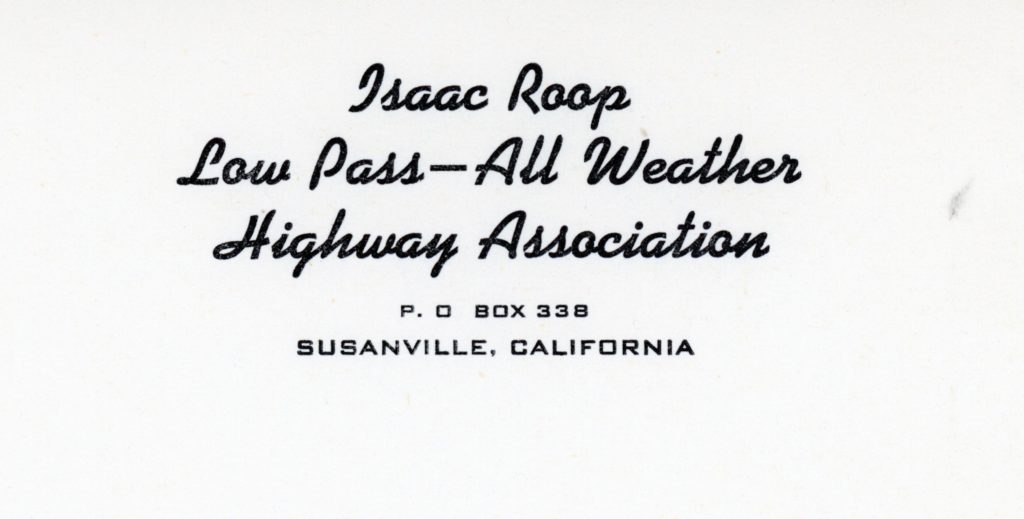
Fast forward a hundred years later. In June 1956 Congress approved the Federal Highway Act, also known as President Eisenhower’s Interstate and Defense Highways. In 1957, Susanville resident F.W. Loosley saw an opportunity and proposed the Isaac Roop Low Pass All Weather Highway, as a viable alternative to Donner Pass. One of the most obvious was it would reduce construction costs and even more importantly annual maintenance, especially where snow removal was a concern. The proposed Roop Highway would go from Winnemucca, Nevada to Viewland, Lassen County, California via Gerlach. There it would merge initially with U.S. Highway 395 to Johnstonville and then connect with State Highway 36 over Fredonyer to Red Bluff. (This should not be confused with the Winnemucca to the Sea Highway.) It received widespread support in California and Nevada. The wheels of commerce, those along the then Highway 40 put pressure because the proposed interstate would bypass them, and they won.
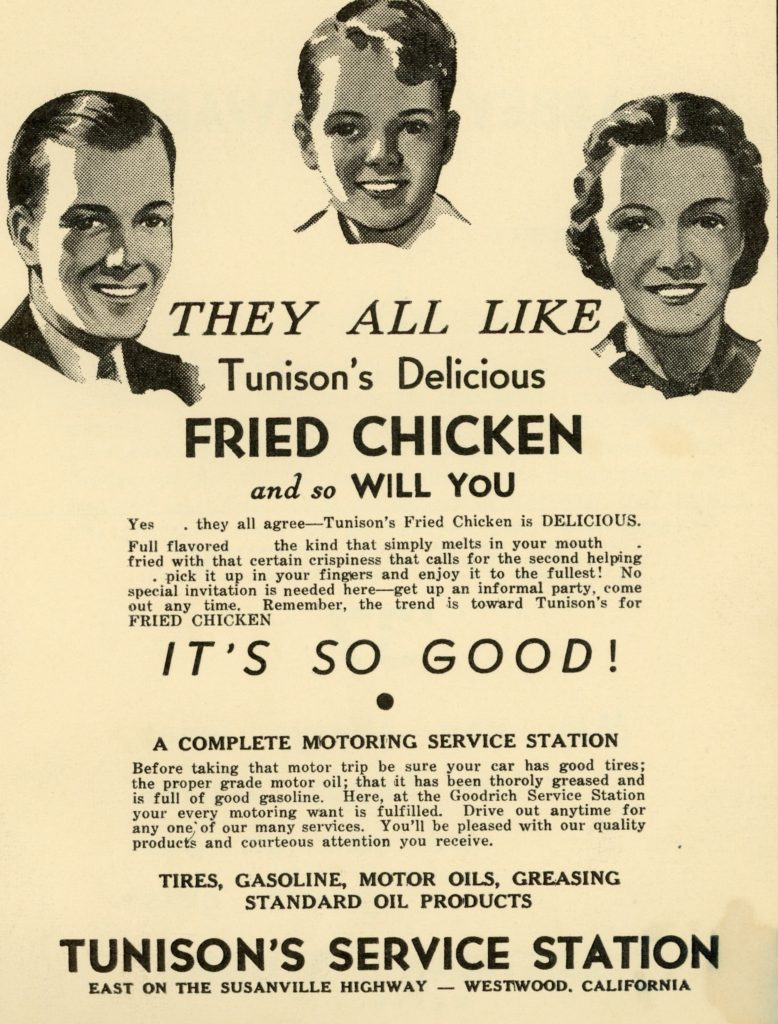
Tunison’s advertisement in the 1937 Westwood Chipmunk
In the mid-1930s, Bill and Jeanette Tunison established very popular bar, restaurant and gas station five miles east of Westwood near Goodrich Creek.* Tunison, it should be noted had been a Westwood resident since 1916. The establishment became very popular in a short order, known for its good food and hospitality. As Marian Hull Herrick recalled, “People would call ahead to see if they serving were Jeanette’s Rum pie that night. People raved about the fried chicken and biscuits. Jeanette confided in me that they were made with Bisquick.”
*The free standing chimney along Highway 36, is the sole remnant of Tunison’s
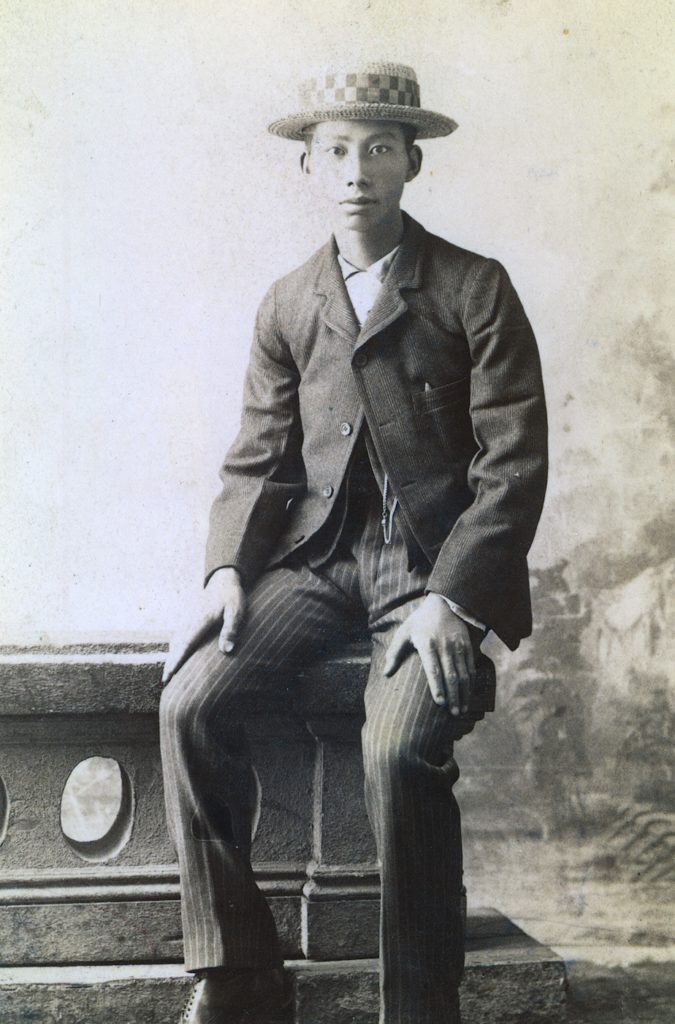
Chin Sin Yu aka Chinaman Joe Folsom Courtesy of Philip S. Hall
Chinese cooks on large ranches were common the late 1800s and early 1900s. This is one of many stories about Chin Sin Yu, known to many as Chinaman Joe Folsom. Joe worked as the cook on the Folsom Ranch, in Willow Creek Valley, north of Susanville and now a State Wildlife Refuge during 1890s and early 1900s. Joe possessed many skills. As Mary Dale Folsom recounted, “It amazes me how Joe found time to do all the things he did. Not only was he the cook, but he had a garden and raised chickens and ducks. He made feather pillows from the duck and goose down. When they were shorthanded he would also get on a horse and help cowboy.” However, he was also known for his skills as a telegraph/telephone operator, that Folsom has installed at the ranch.
Mary Dale wrote: “A wealthy man from the Bay Area, I believe his name was Butters, had some cattle on the Folsom Ranch at Willow Creek. that my grandfather [M.O. Folsom] was feeding for the winter. Mr. B was an avid duck hunter and belonged to an exclusive duck club in the Bay Area. Joe was an excellent duck shot and had a well trained dog. Mr. Butters came up to the ranch at my grandfather’s invitation to hunt ducks. when he arrived, everyone was busy, so Grampy sent Joe to hunt with Mr. Butters. Afterwards Mr. Butters told Grampy he had been rather insulted to have the Chinese cook sent with him. Mr. B. had an expensive shotgun and a professionally trained purebred retriever. Joe had an ordinary shotgun and his dog was not purebred. After they had been shooting for sometime, the ducks were thick and Joe let Mr. B. do all the shooting. Mr. B. had been able only to bag a few and his dog had not worked well. Joe’s dog did most of retrieving. Joe was getting nervous as it was becoming late and he had to get back to ranch and get dinner. He started shooting and bagged a bunch of ducks to make the hunt successful. Mr. B. was completely amazed and impressed with Joe’s shooting and his dog. He asked Grampy if he could take Joe down to his duck club and show the other members what a super shot and good dog were like. Grampy was afraid the members would make fun of Joe and hurt his feelings so he said they were too busy to let Joe go. Not long after Mr. B. sent Joe an imported English shotgun and a green English Shootingsuit. Joe was thrilled and proudly wore his suit whenever he went hunting. As I remember father [Lou Folsom] said it was quite elaborate and included knicker type breeches. He said it was too bad they didn’t have a picture of Joe in his English regalia.”
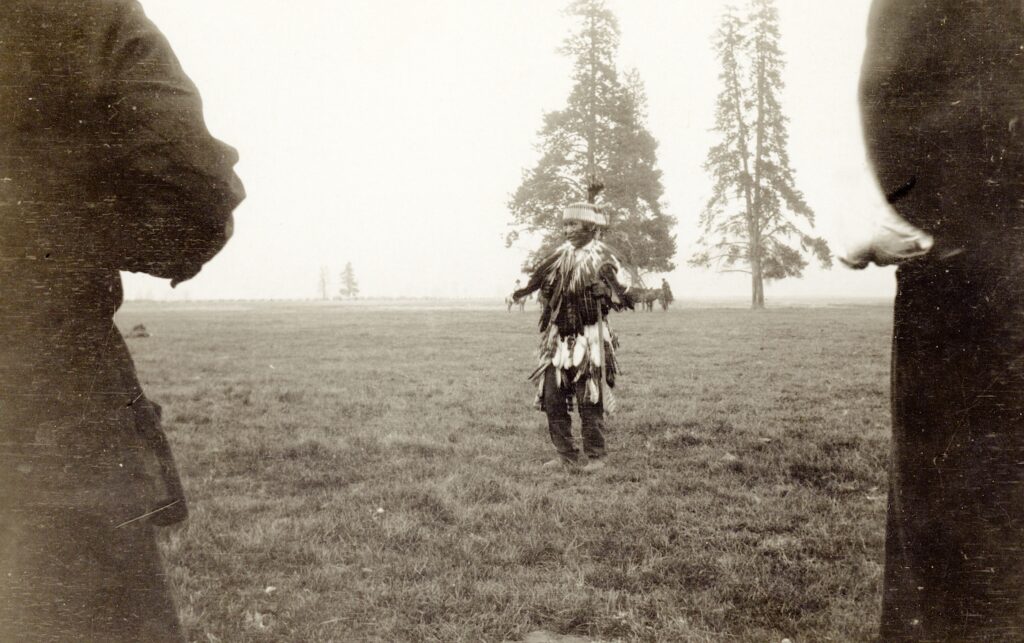
Big Meadows Mountain Maidu dancer, 1911-Courtesy of Hazel Moller
My holiday activity will be spent retrieving old research files from some cd’s. A generous friend provided me with a USB SuperDrive to do the task. I thought I had printed out a hard copy of my notes on the local Native American community dating back to record searches of late 1800s from my older computer files. There are gaps in that print out, so hopefully the full file will appear on the cd. After all I have gone through several computers, and the older ones, there had been problems of file transfers. Who knows what gems I might uncover.
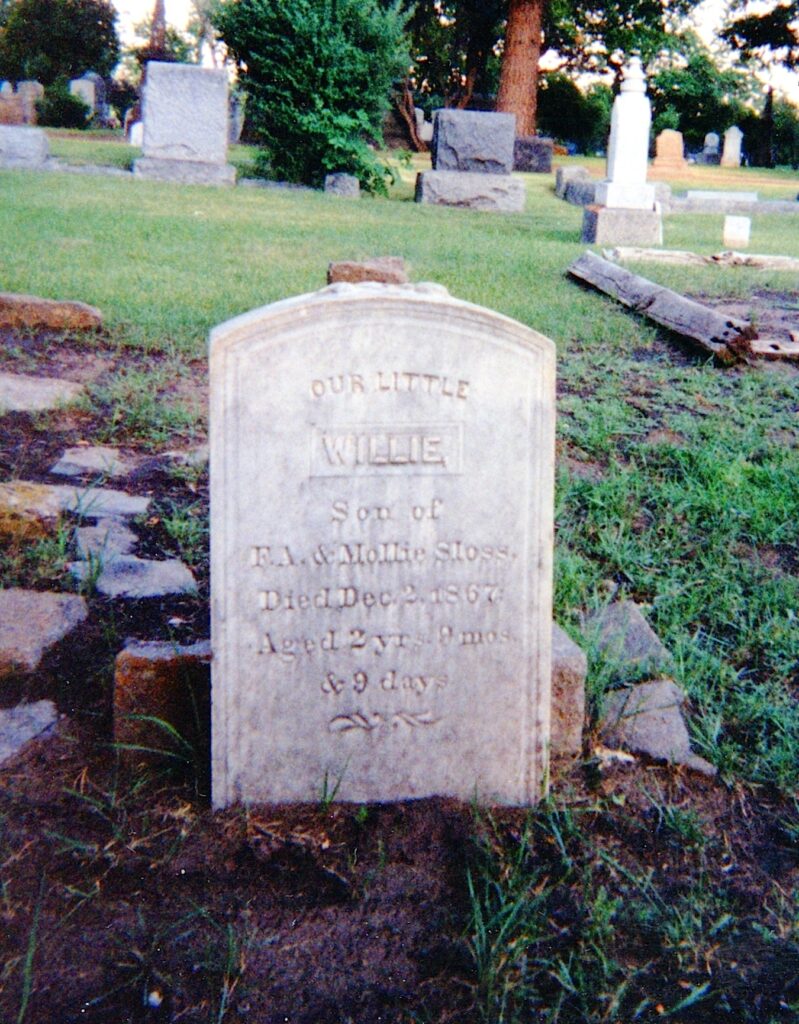
It is a small stream that flows through Janesville and is tributary to Baxter Creek. It was named for Ferdinand A. Sloss (1832-1889) who came to the Honey Lake Valley in 1859. In 1860, Sloss opened a combination saloon and bowling alley at that then booming mining community of Richmond. The boom was short-lived he relocated to Janesville along the creek that bears his name. In 1872, Sloss sold his property at Janesville and relocated at Susanville.