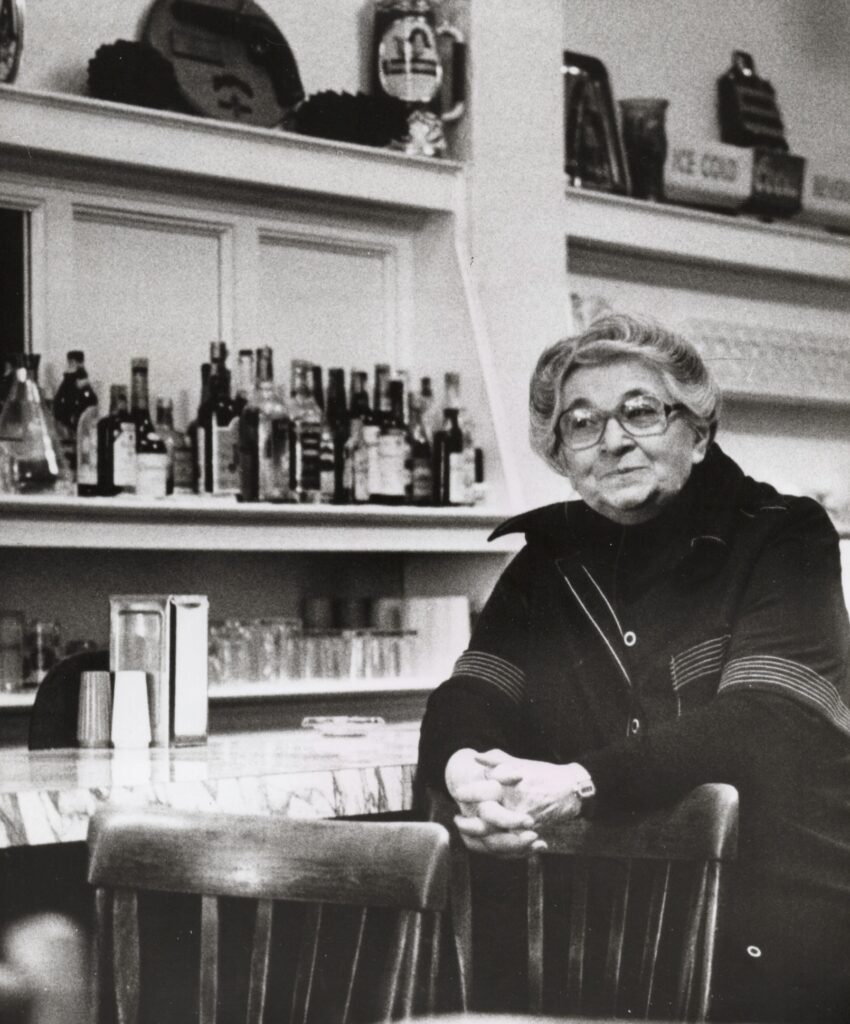
Note: This Associated Press article was authored by Lisa Levitt and published in February 1984. A few years back the Sargent family sold the Grand Cafe. It going through extensive remodeling. Herewith is the article:
On a certain Main Street in a certain tiny Sierra foothills town, half a century has gone unnoticed. Time paid a visit to the Grand Cafe around 1935, and it hasn’t been back since. Helen Sargent survived The Thirties with the restaurant, and looking at them now, it’s tough to say who did it in the grandest style.
Surley, one would not the be quite so grand without the other.
In 1928, when the dark-haired, blue-eyed 20 year old came here to live with her husband Steve, in the big house at the corner Main and Grand, Susanville had 1,500 people and the Grand Cafe. Today, it has over 7,000 people–and the Grand Cafe.
And it still has Helen Sargent, whose hair has gone soft gray but whose eyes are blue as ever, and who, on any given winter morning, walks slowly down her icy steps with the aid of a cane to a waiting cab that whisks her the four blocks to her restaurant.
There, somewhere between the sidewalk and the beveled glass door, 50 years took the day off.
Perhaps it was the trauma of the wall that collapsed in 1933 during construction on an adjacent building. May be progress just passed the Grand by. Maybe the Sargents never let it in the door.

Whatever the reason, the Grand Cafe if the Thirties incarnate, from the trio of tall, silver coffee urns to the water pitchers to the table side jukeboxes from the Capehart Music Corp. of Fort Wayne, Ind. Wooden refrigerator units cool drinks behind the 30-foot counter, lined with its 16 high-backed stools. The backbars have inlaid mirrors; the one carved wooden booths were shipped in from San Francisco. “Air-cooled” says one neon sign. “Cocktails” says another.
“Everything in here is 48 years old, except the stools–they’re from the Twenties” says Mrs. Sargent, who happens to be from 1908 herself.
It’s her one day off in a work week of six 14-hour days, but she’s is happy to show off her place that has bee the centerpiece of her life for so long, to switch on the reddish-pink neon in the windows and fire up the monstrous oil-burning stove.
“I didn’t really work too much until the war broke out, and our help went to the defense plants,” Mrs. Sargent says. “One day in 1940, our two waitresses left, and that’s day I came to work I just thought after the war everything’s going to settle downwind be the way it was. But it was never the same again.”
At her home, filled with hand-colored photos and overstuffed furniture that sinks as you sit. Mrs. Sargent keeps a picture of the Grand circa 1931 that shows a cook, busboy, head waiter and her husband–the chef–holding the hand of their eldest three sons.
Two years after that picture was taken, disaster struck.
“The worst year for the Grand was 1933. That was the year the Grand Cafe collapsed,” she says. “It happened at 9:30 a.m., just as two people were going out the door. That took us nine months to rebuild.”
Reconstruction didn’t take faze the Grand, which reopened in 1935. It looks much as it did in the photo, but the staff has been reduced to one most of the time.
It’s Mrs. Sargent who passes out the menus, takes the orders, cooks the meals, clears the table, washes the dishes, orders the food and keeps books in her “office,” as she calls the table at the back of the cafe. A waitress and dishwasher help out at noon, the Grand’sbusiest time.
“I soon found out I had to do more. I couldn’t depend someone else,” Mrs. Sargent says of her working during the war years.
Her workload, which had consisted mostly of planning banquets in the early days, gradually increased until his husband’s death in 1974, when she took over completely.
After her husband died, she embarked on a 10-year plan of renovation. One year, it was a new roof on the Grand; another year, the dining room was painted. Last year, the kitchen walls got a new coat of paint and new linoleum to lay in the kitchen and banquet rooms.
Mrs. Sargent goes in at 8 a.m. every day, except Tuesdays when the Toastmasters have their breakfast in the banquet room behind the kitchen and she get in by 6:15 a.m. to prepare. Recently, banquet business has picked up a bit–a nuclear awareness group has started having lunch every Tuesday and there’s the Republican women every month.
Leg surgery last year forced Mrs. Sargent to take the first vacation of more than week that she had in a decade. The Grand was closed for nine months and she admits some customers thought she wouldn’t be back. But she was.
“The doctor said, ‘I expect you to be active, but don’t overdo it. And don’t park it,” says Mrs. Sargent, who doesn’t seem to know how to park it and doesn’t appear ready to learn.
“I miss my people. I miss my schedule. I have one more year to accomplish all the things I want to do,” Mrs. Sargent says, noting that her sons want to keep the Grand, even if she actually retires.
Support