In the summer of 1964, Robin McVickers and Fred Toler formed the Northlands Holding Company for their newest endeavor. The two men purchased four of the old Fruit Growers Supply Company’s apartments on Alexander Avenue in Susanville from the Eagle Lake Lumber Company. The buildings were completely renovated, became known as the Riverside Apartments when they were opened in September 1965. One building, in particular, was dubbed “The Chateau.” This building was specifically set aside as a dormitory for Lassen College students and could accommodate fifty-six students. This apartment complex still exists and is known as the Parkview Garden Apartments.
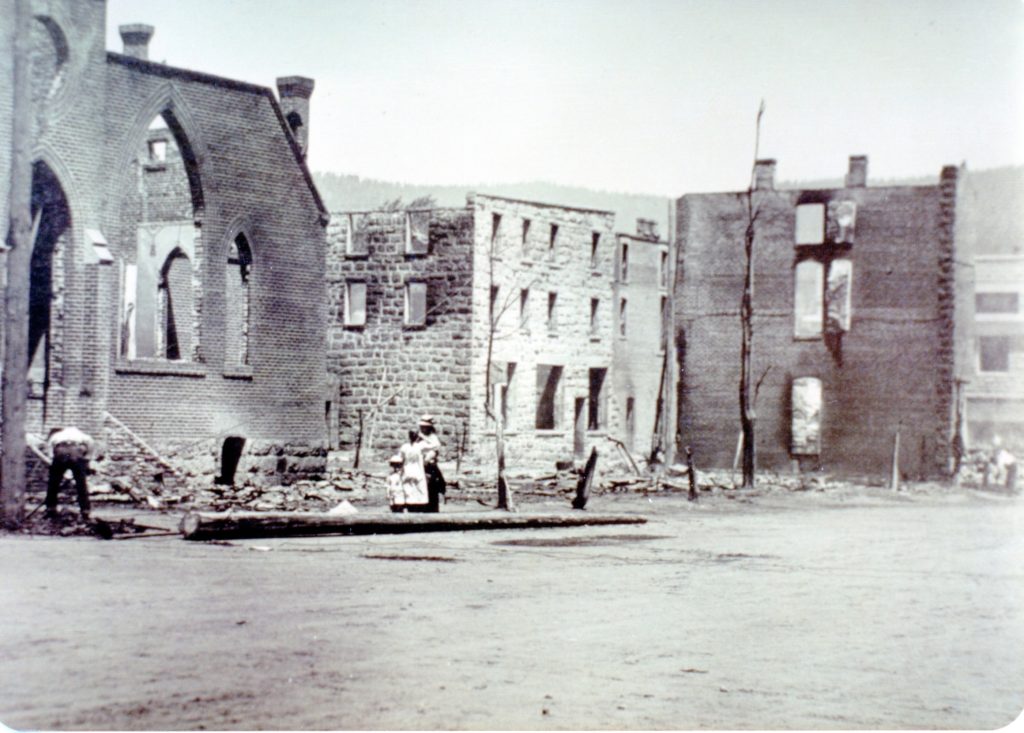
The ruins of the Methodist Church and Emerson Hotel, August 6, 1915
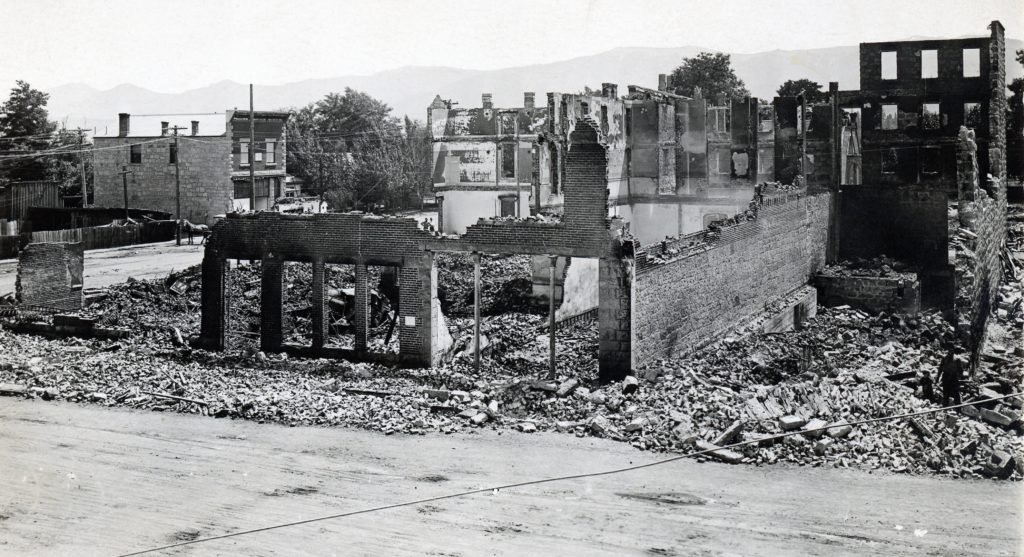
In a twenty-five period from 1894 to 1919, Susanville witnessed some of its most devastating fires. It first began on August 14, 1894 when the Bremner sawmill and Anthony’s electric light plant on the Susan River caught fire and was destroyed. It was followed by the Knoch Building fire of August 9, 1898. The Blue Goose Saloon also burned down on August 9, 1912, which sported the town’s first electric neon sign. The Arnold Mill fire of August 6, 1914, was followed by the destructive of fire of August 5, 1915 that consumed the Emerson Hotel, Hyer House Hotel and the Methodist Church. The photograph of that fire shows the intensity of the heat leaving just the brick wall shells of the Emerson and Methodist Church. Located between the two was the two-story wooden Hyer House Hotel which was completely wiped out. The last of these fires was when the majority of the north side of the 700 block of Main Street that destroyed the Hotel Lassen among other things on August 14, 1919.
The Emerson Hotel ruins. Courtesy of Vivian Hansen
From time to time the local health officials raised concerns about swimming in the Susan River. Take for example of an incident that occurred in 1945. In early June, Dr. J.W. Crever, Lassen County Public Health Officer issued a polio alert. By mid-August, Crever noted that there was a decline of people using Roosevelt Pool and an increase of the same in the public using Susan River. Crever stressed swimming at the pool was much safer than the Susan River. Shortly thereafter he declared the polio threat over and only one case reported.
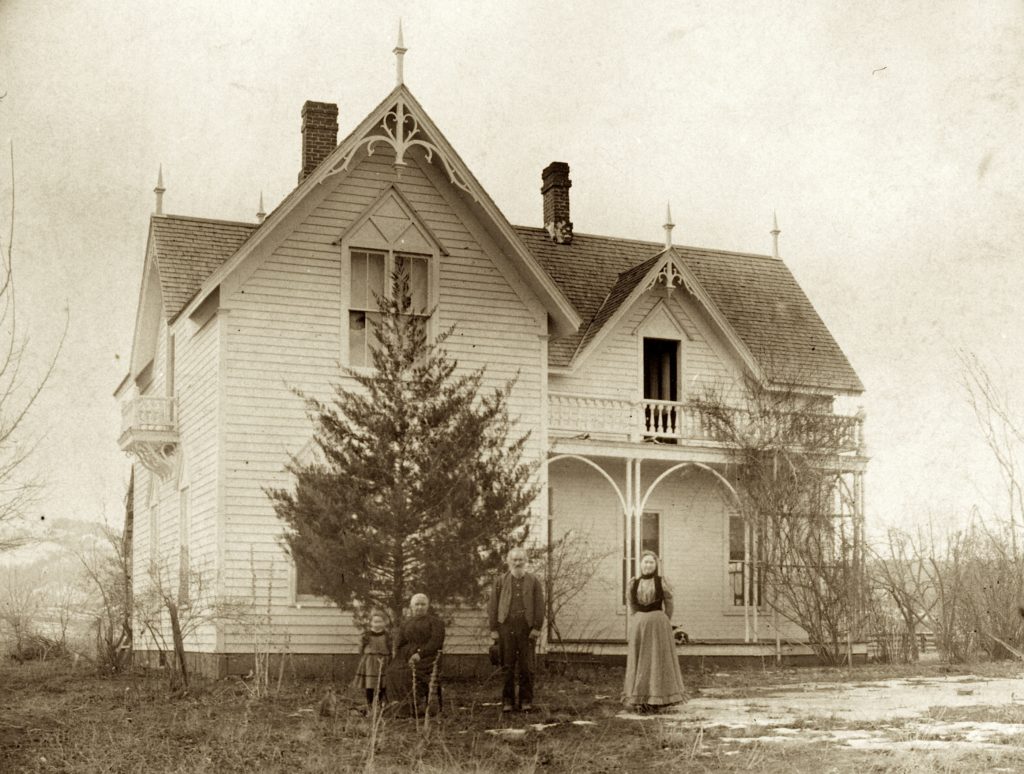
L.D. McDow Residence. Courtesy of George McDow, Jr.
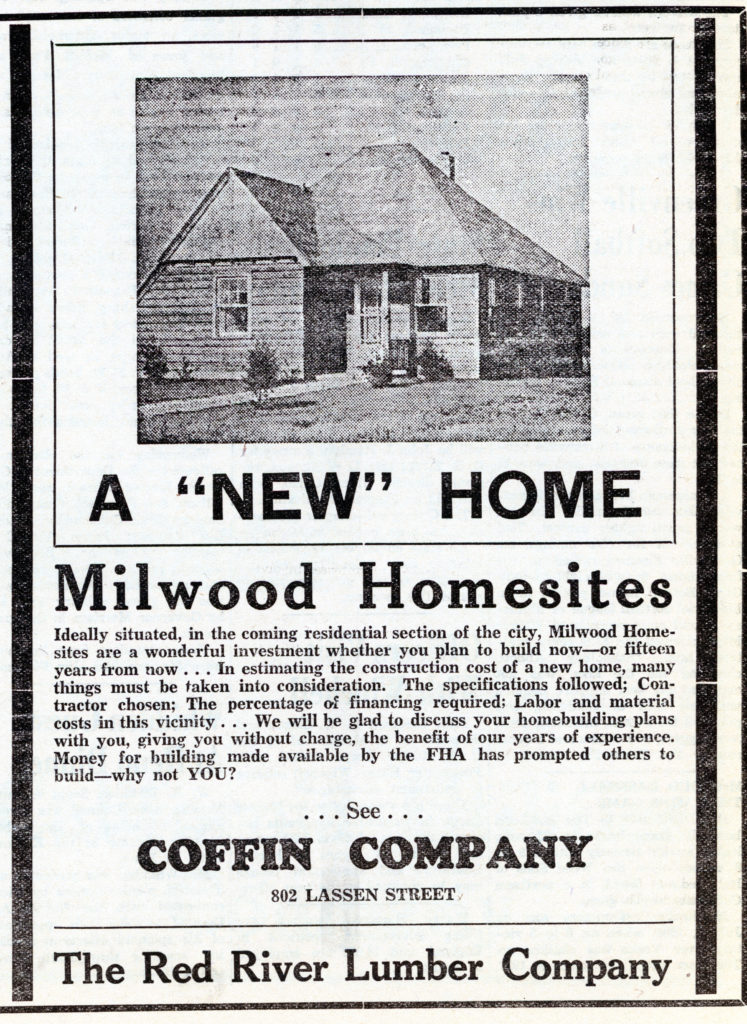
It would take nearly a half century for Susanville, as a municipality, before it was able to expand its boundaries. Of course, politics played a pivotal role and the city’s most formible opponet was the Red River Lumber Company which owned the Milwood Tract east of the city limits.
Annexation efforts tried and failed with Red River’s influence. In the summer of 1928, the residence of J.A. Metz, who lived in the original McDow home in the Milwood Tract was destroyed by fire. Since it was outside the city limits there was no fire protection in Milwood and adjoining subdivisions. The fire prompted a petition drive for annexation. It was met with opposition and they were able to stop the movement in its tracts.
In 1930, an annexation campaign was resurrected. A committee was appointed to investigate the many issues and report back to a public meeting scheduled for March 10. It was decided to take a poll in the Halltown and Milwood Districts to obtain the residents’ pulse on the measure. For the proponents it was not good news. The initial poll showed 156 against annexation to 47 for it. End of discussion and remained that way for nearly a decade.
During the 1910s, real estate developers went through a crazy period putting together subdivisions adjacent to Susanville with the anticipation of a major “boom” once the railroad arrived. For a brief time it subsided, but went crazy again when it was announced the Fruit Growers Supply Company was to build a substantial lumber manufacturing adjacent to Susanville.
Enter George McDow, owner of the local title company, Lassen Abstract, and his best friend, Russell Brownell, the latter known for his salesman skills. Having inside knowledge they acquired property on the north side of the Susan River of the proposed Fruit Growers millsite. They created the Milwood Tract subdivision, that adjoined Halltown. This subdivision extended Second, Third and Fourth Streets. It also created the streets of River, Sacramento, Spring, Fairfield, Mesa and Gilman. The developers designated the east end as Milwood Farms. They were made 34 two-acre lots for those who desired extra room to raise chickens, plant gardens and the like. Two streets were created, but never named until later. One became known as Russell Avenue, after Russell Brownell, who died unexpectedly in 1923. The other became Fair Drive, since it would be the main thoroughfare to the fairgrounds that were built in 1922, adjacent to Milwood Farms.
Things did not go according as plan. In September 1922, they sold 260 acres of the tract to the Red River Lumber Company, who bought as speculative property as a future millsite. That transaction had a major impact on the history of Susanville, which we will explore tomorrow.
This was the name of Lassen College’s first student newspaper. How it came to be was pure accident, as it was not planned. In September 1939 the college offered a Creative Writing course. It was a venue for students to practice writing news article and general composition.
At the beginning of the second semester the class published a mimeographed newspaper, the “Jaysee.” By February the paper came out on a weekly basis. There was no assigned editor. Instead to give everyone an opportunity for a hands on approach, each week everyone rotated assignments.
The initial paper was financed by selling candy bars at the basketball games. In April it was deemed necessary that it would need an advertising department to finance future issues.
Fast forward to the Spring of 2019 and a new online student newspaper is now published at Lassen College known as “The Paw.”
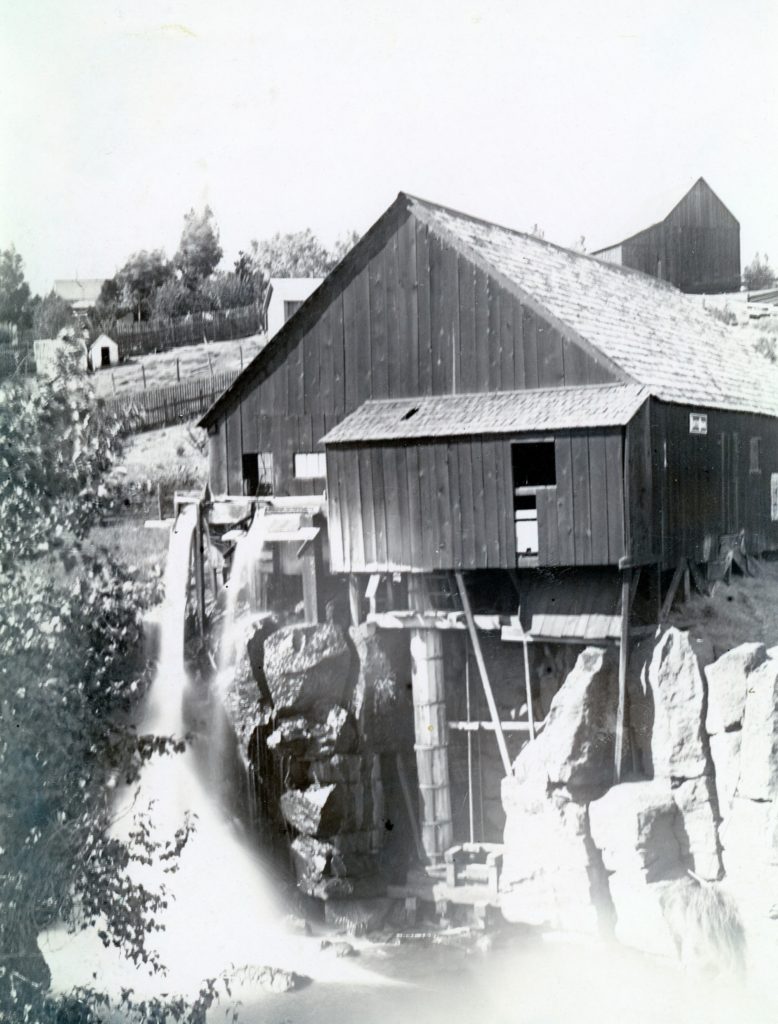
Arnold Planing Mill, circa 1905. Courtesy of Philip S. Hall
For many years the Arnold Planing mill located adjacent to the Richmond Bridge, Susanville, was one of the most photographed sites.
It was built in June 1873 by L.J. Abel and George Barley. This, like the other mills in the era, was powered by water. They constructed a ditch and flume about a quarter-mile upstream on the Susan River from the mill. It became known as the Arnold Ditch, and while it no longer conveys water, it is still used as a reference point to determine property boundaries. The mill primarily manufactured doors, sash, blinds, furniture stock, cornices and other related items.
In 1877, Abel & Barley sold the mill to Ezra P. Soule for $1,526.15. In that same year, Ezra’s daughter married Leroy D. Arnold. Shortly thereafter, Leroy operated the mill. In 1912, he retired and his son, Ezra Arnold took over operations.
On August 6, 1914, at approximately two in the morning, the residents of Susanville were awakened from their slumber by the alarm of fire. The Arnold mill had caught fire, and little could be done to save it. It was severe blow to the younger Arnold, his loss estimated at $10,000 was not covered by insurance. It was believed that a hobo had camped there for night, built a small fire to prepare a mill, but never fully extinguished it.
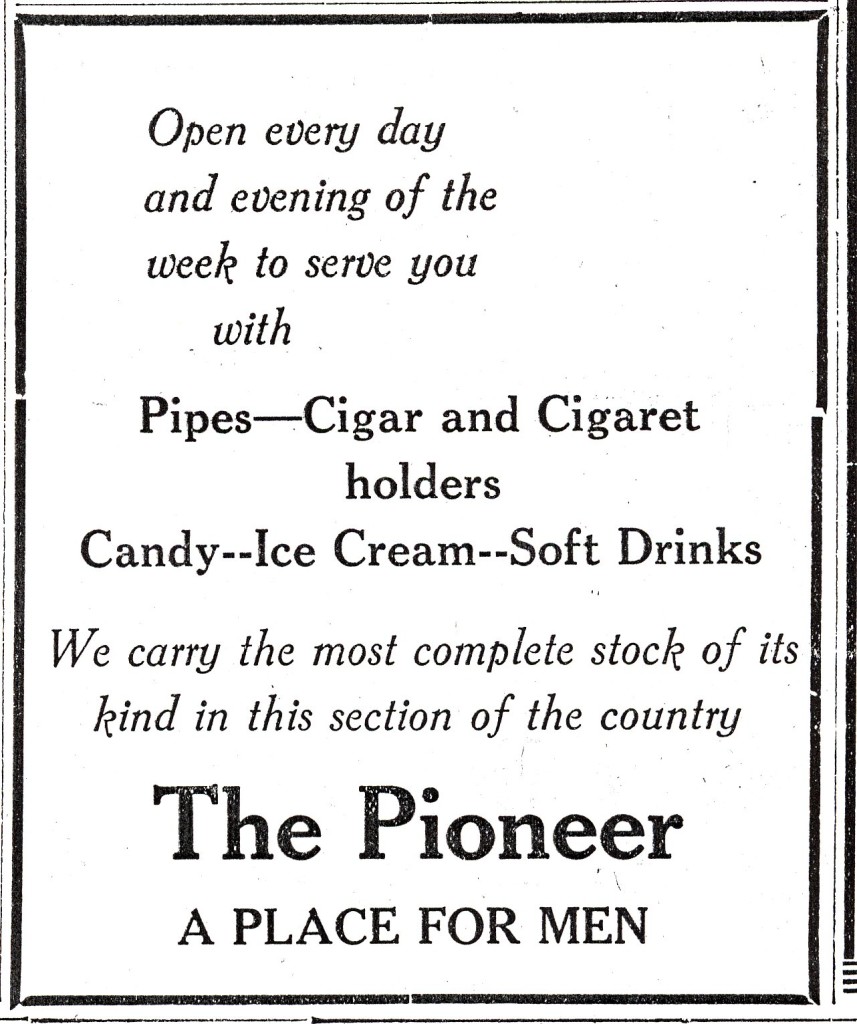
A 1920s advertisement for the Pioneer. It had to change its ways during prohibition.
In 1920, Grass Valley business man W.H. Tuttle purchased the Pioneer Saloon, Susanville’s oldest business. For many this was something a deranged person might do, since the nation’s prohibition of alcohol had just been implemented. Not only that, Tuttle announced he was going to replace the old wooden structure with a two-story concrete one.
To make up for the lost revenue from the sale of alcoholic beverages Tuttle branched out into the wholesale mercantile trade. In a very short time this enterprise turned out to be very lucrative, he specialized as a distributor of tobacco products and candy. In 1929, he sold the Pioneer Mercantile Company to John Solari and M.A. Griffin. After the repeal of prohibition the mercantile aspect continued until the late 1970s.
Seasoned residents will remember this store located at 711 Main Street which is currently occupied by Iron Horse Gym. M.A. Griffin came to Susanville in 1912 from Loyalton. In 1920, at this location he operated a men’s clothing store. Griffin along with O.C. Watts revamped the men’s store into a five and dime variety store, and it opened on March 7, 1936. It was affiliated with the Ben Franklin stores. Griffins closed down in the 1960s and was replaced with Super 88, a similar type of store.
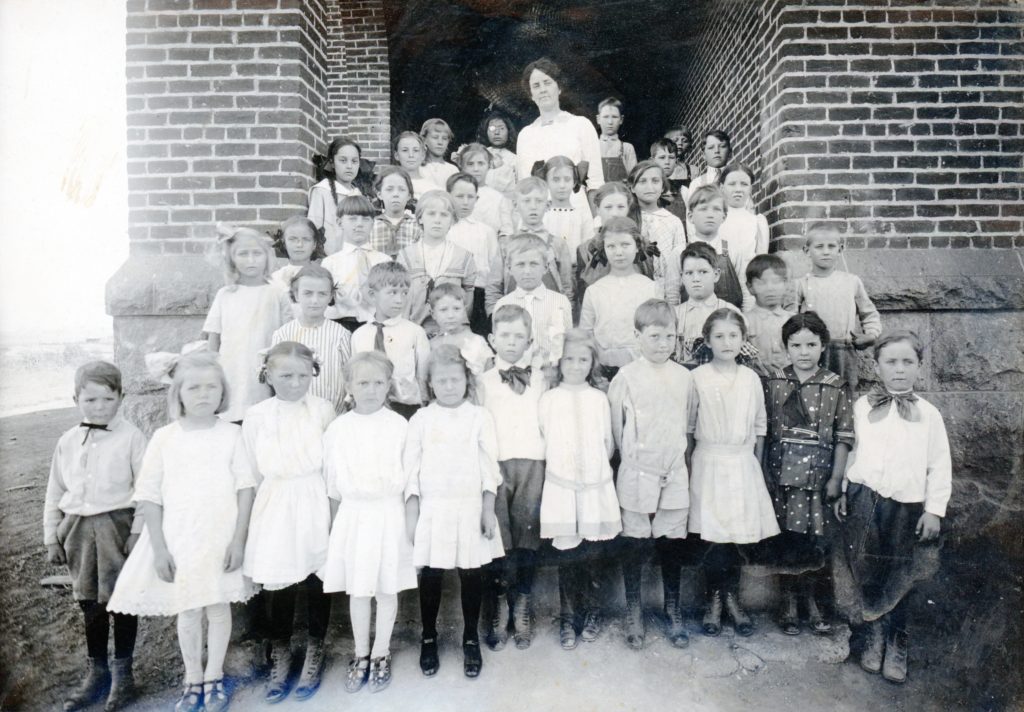
First Grade, Susanville Grammar School, 1914, teacher Mrs. Tom W. Wilson—B.R. Zimmerman Collection
It seems of late, that on a almost daily basis measles is in the news. There was a time when other communicable diseases made headlines. Locally, in the spring of 1916 a scarlet fever epidemic hit Susanville. Not to take any chances, school officials closed the Susanville Grammar School for a week, hoping that would be sufficient enough. It was.