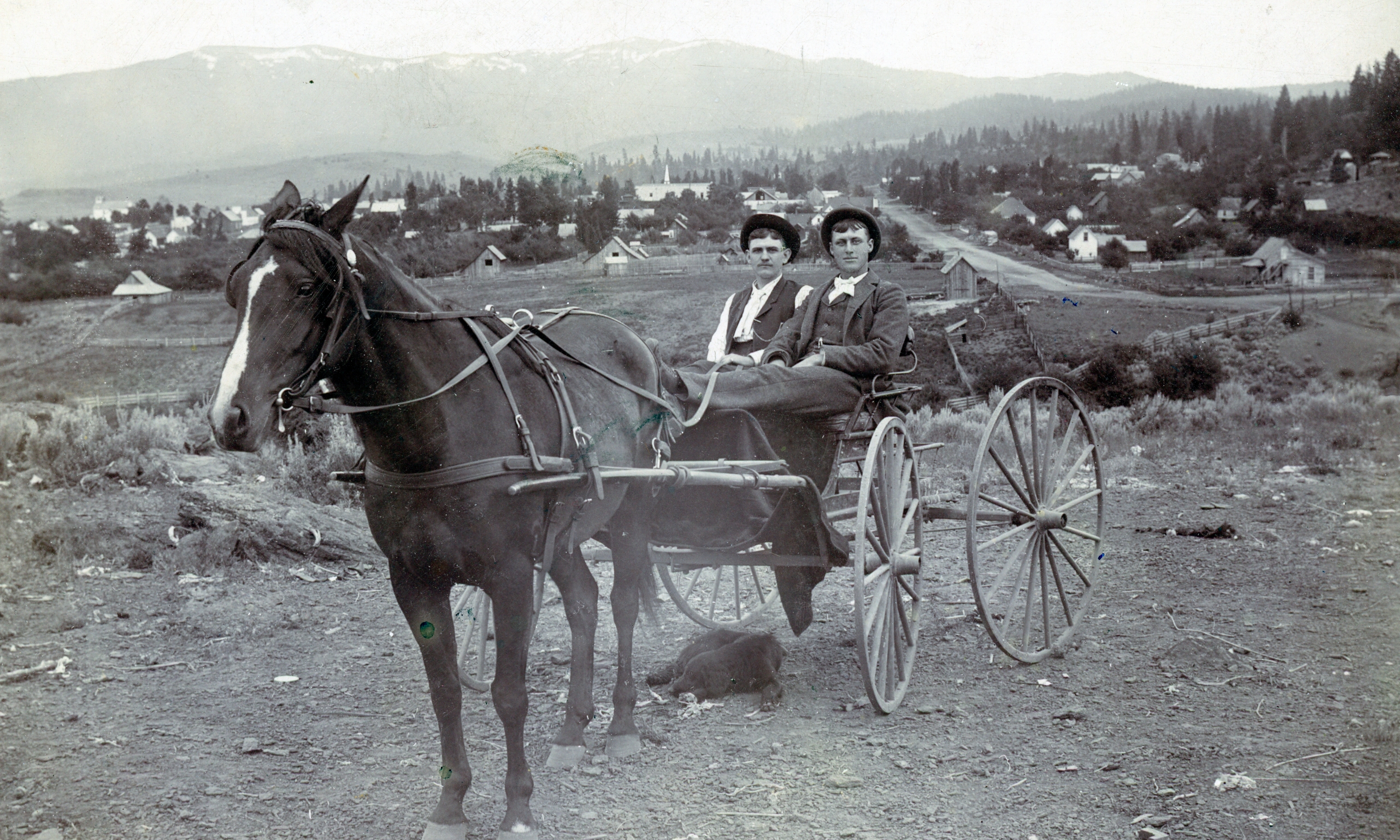
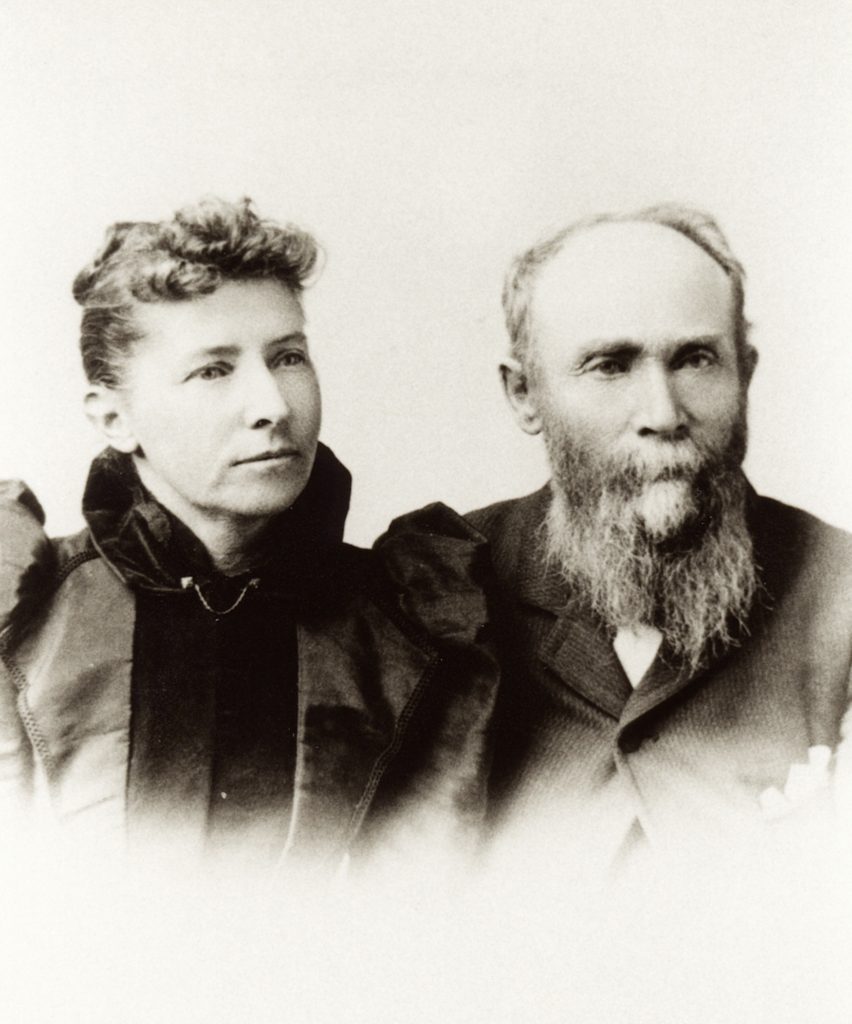
Susanville’’s Roop Street in the background from Rooster Hill. Seated, Frank League, Charle’s only son and Tom Long, circa 1895.
To be a teamster in the region during the 1850s and 1860s one encounter many hazards. While poor road conditions was one item one of worst was the conflicts between the Indians and the Anglo settlers. In Fairfield’s Pioneer History of Lassen County e devotes nearly a quarter of its content about these conflicts.
In October 1867, Susanville merchants Griffin and Williams hired Charles League to take a load of merchandise to Summit Lake is far northwestern Nevada. After League unloaded his wagon, he began to make the journey back to Susanville. He stopped at Flowing Springs Station for the night operated by two Honey Lakers, L.M. Crill and C.P. McClelland. During the night the dogs barked continuously, a good indicator that Indians were around. With that in mind, Crill and McClelland tried to convince League that he should stay as a matter to safety precaution. It did not work, and League hitched up his team and wagon and started for Honey Lake Valley. It was not too long after, Crill and McClelland spotted smoke on the horizon. Crill and McClelland mounted their horses to follow League. They had only travelled a little over a mile, when they spotted some Indians going up the hillside with League’s horses. Near the wagon they found League’s dead body. The authorities at Camp McGarry were notified and a crude coffin was made, and League’s body brought back to Susanville for burial. This would be one of the last conflicts in the region.
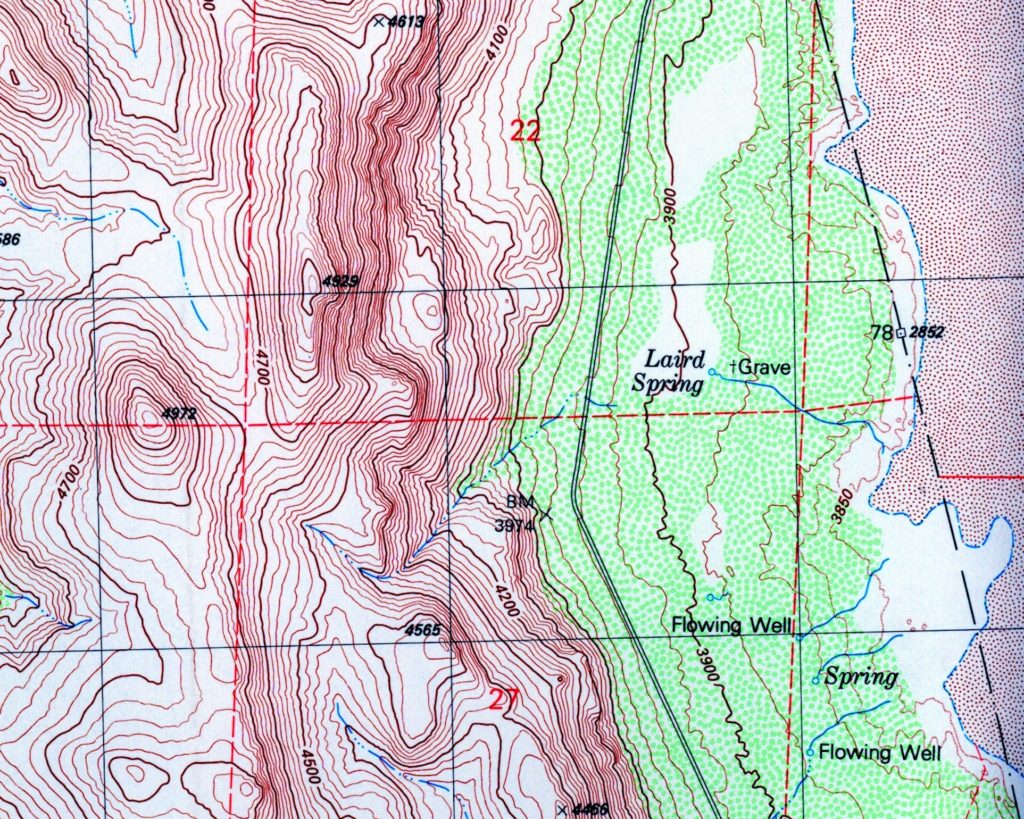
Numerous springs in the Intermountain West are named for wranglers and itinerant sheepman. Laird Springs is one, that has an interesting story, and one of which is still an unsolved murder.
Edward Laird was born in 1862, the eldest of three children, his two siblings Margaret born 1863, and brother Warren in 1864. They were orphaned at an early age and raised in an orphanage in Carson City, Nevada. As young men, Ed and Warren went to work on various ranches in Northeastern California. By the late 1890s, they had settled in the North Warner Valley, Lake County, Oregon. Warren would remain in Lake County for the rest of his life.
In the early 1900s, Edward Laird worked as a ranch hand at Round Hole, Smoke Creek Desert, also known as Bonham Ranch. The owners William and Martha Bonham Ross, were in-laws to Laird’s sister, Margaret Sutcliffe.
Very little is known of Laird’s activities on the Smoke Creek Desert. Sometime after 1910, Laird filed a “squatter’s claim” to eighty acres, three miles north of Round Hole. There was a spring on the claim where he built a cabin. Edward Laird was murdered on or about August 20, 1917. Details of his murder are sketchy. According to newspaper reports, his body was marked with two shot gun wounds and he was found dead in his cabin. On August 29, 1917 the Nevada State Journal had a caption, “Revenge Believed to Have Been the Cause of Killing With Shotgun near Round Hole.” However, the newspaper did not provide any details. A week later area ranchers offered a $500 reward for information leading to the arrest and conviction of the party who murdered Laird. That was basically the end of the case. Cook Laird, Warren’s grandson, told me that Edward was a red head who was known to be hot headed with a mean temper.
Edward Laird was buried 100 yards east of where the spring bears his name.
Many years ago, I wrote a weekly historical column for the Lassen County Times. At that time, I contacted Eric Moody, who was researching Flanigan, and I asked him to write an article. He obliged and here it is.
Flanigan was to be the most important community in eastern and southern Honey Lake Valley, a major rail center, situated in the midst of a rich agricultural area, boasting hundreds, perhaps thousands of inhabitants.
At least that was the grandiose dream of Flanigan’s founders. In reality, the small town located five miles inside Nevada at the intersection of the Southern Pacific and Western Pacific tracks never boasted a population more than fifty and never became a center for much of anything.
The place did exist, though, for seventy years, 1909 to 1969, and its history isn’t as lacking in interest as its meager population would seem to indicate.
Flanigan first appeared in late 1909, when the Western Pacific Railroad built its main line through eastern Honey Lake Valley. By January of 1910 a Western Pacific station was in operation there. The station disappeared the next year, but in 1912-1913 the Southern Pacific built a branch line from Fernley, Nevada to Susanville and Westwood, and the new line passed that of the Western Pacific at Flanigan. Southern Pacific buildings were set up late in 1912, and the next year a station established.
With this, the time seemed ripe for promotion of the site. Two Oakland speculators, C.A. Ross and George Warnken, had a townsite laid out on land they owned just west of the Flanigan railroad intersection. Their projected community, taking the same name as the station, was to have thirty blocks with 900 lots, a school and a library.
Promotion of the new town began, with the principal “pitchman” being Paul Butler, a one-armed dynamo who had been hired by Ross and Warnken to be their agent at Flanigan. Scores of curious visitors were ushered around eastern Honey Lake Valley, and over 200 town lots were sold. By 1914 Flanigan boasted a post office, a general store, and a spacious forty room hotel—built and operated by Paul Butler, who confidently predicted that Flanigan was going to become a major rail center—another Roseville, or at least another Sparks.
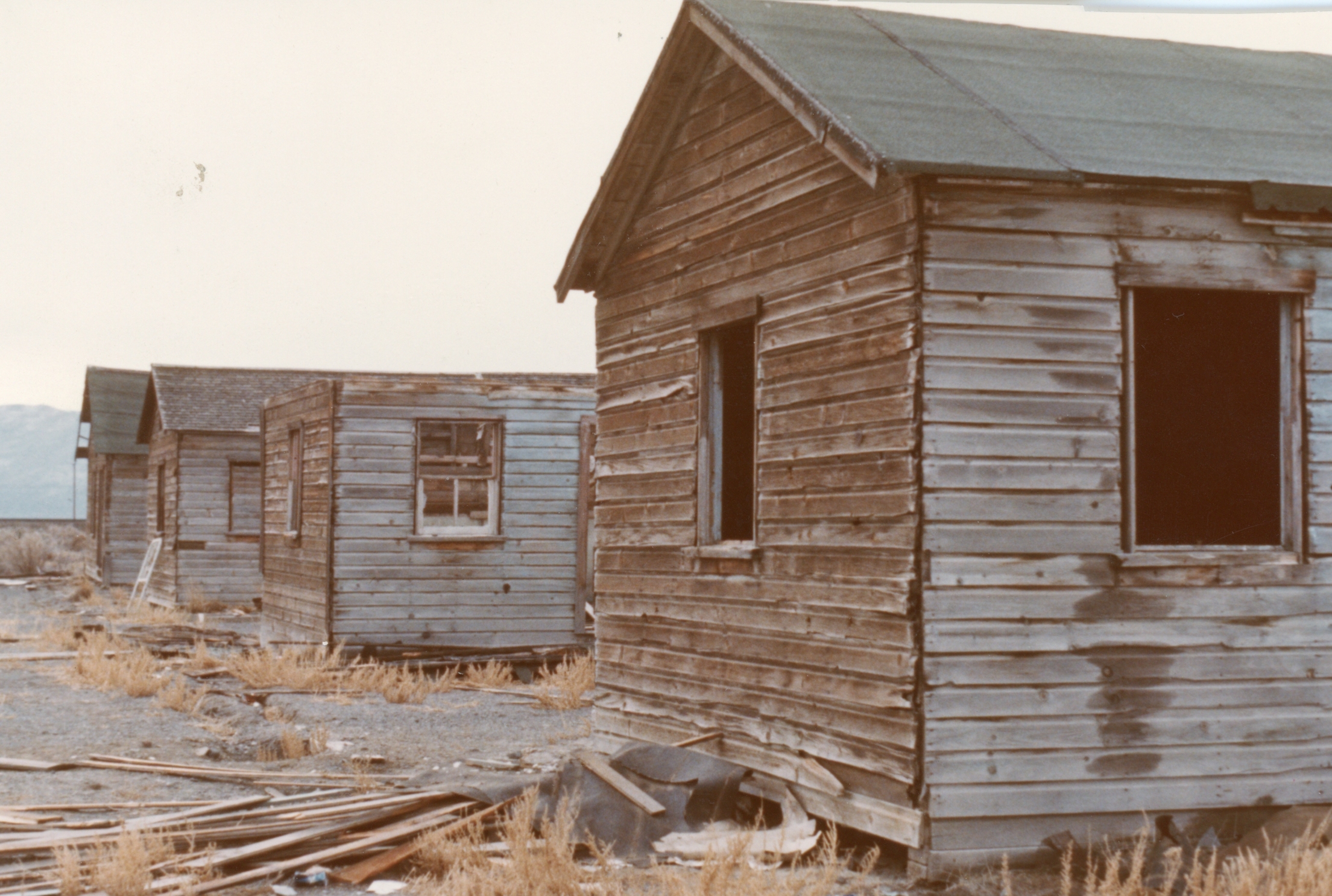
Cabins on A Street, Flanigan, 1976–Christopher Moody
Unfortunately, Flanigan didn’t develop much more. Butler continued his promotional work into the mid-1920’s—even trying to drill for oil and developing a bog lime, or marl, deposit nearby, but even he finally gave up. In 1924 he sold his store to Orlando Gasperoni, then a Southern Pacific section foreman at Flanigan, and in 1926 the practically unused hotel was sold for its lumber and torn down.
Flanigan went on living, but its existence was quiet and relatively uneventful. There were some further attempts to drill for oil or gas and the marl deposit continued to be worked. The Bonham School (formerly located at the Bonham Ranch) opened its doors at Flanigan in 1929, and dances, which drew people from all over the area, were held in the school building. In 1934 Orlando Gasperoni sold the store to William and Gertrude Milne, who had come to Flanigan four years earlier when she had been hired to teach school.
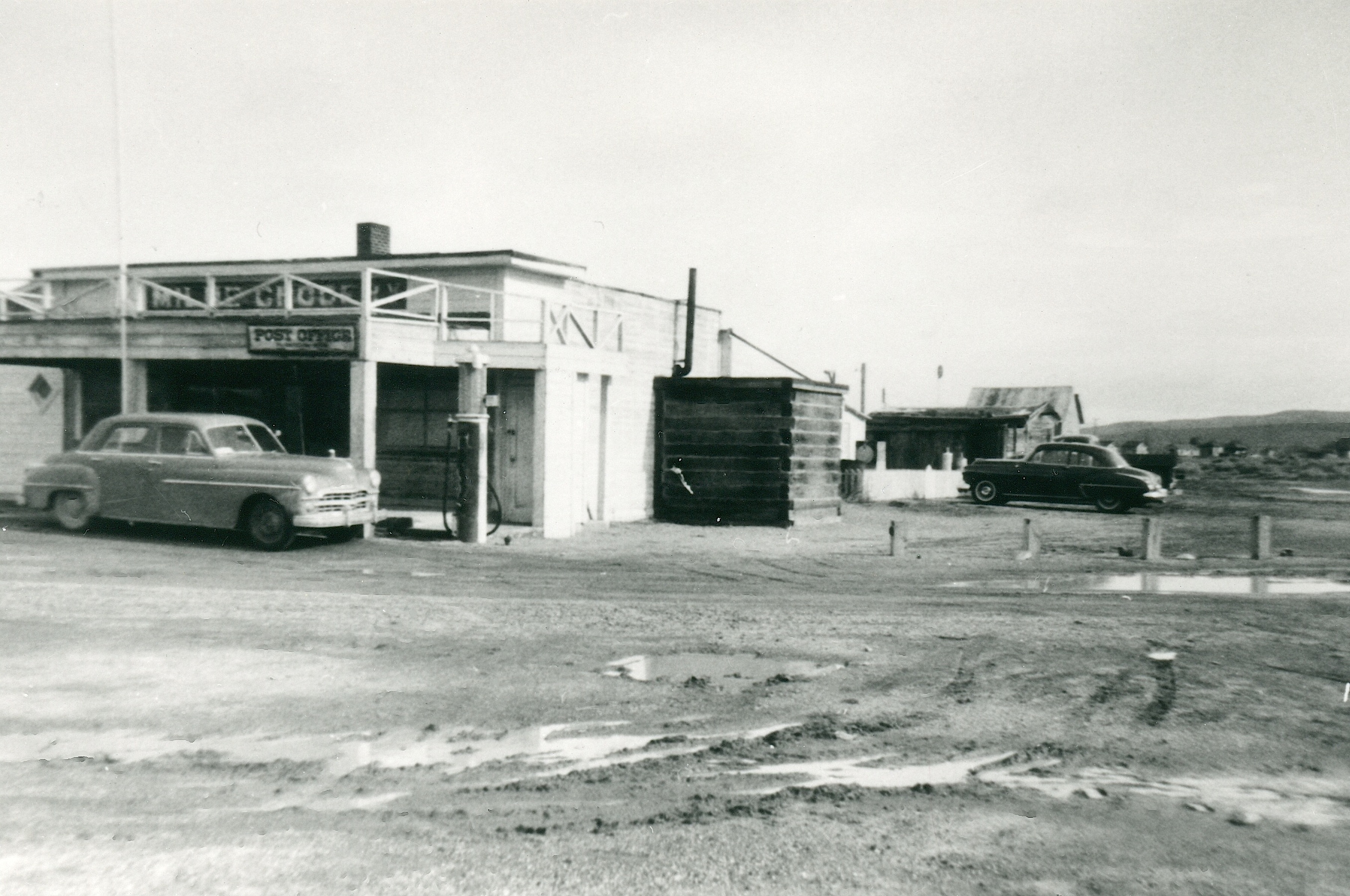
The Milne Store, 1950s. Courtesy of Dorothy Carnahan.
It was not until the late 1950s that things at Flanigan really began to change—for the worse. In 1959 the Southern Pacific pulled out its section crews, and shortly after that the Western Pacific did the same. In 1961 the post office shut down. It had been located in the store, which had closed its doors in the middle 1950s.
Flanigan remained alive only because of the school, where a commuting teacher taught a handful of students, and Mrs. Milne’s continued residence at her home which was attached to the closed store.
The year 1969 saw the end of Flanigan. Early on the morning of January 2, while Mrs. Milne was away visiting at the Fish Springs Ranch, the store with her attached home, burned to the ground. And that summer the school, the last one-room school in Washoe County, was closed because of a lack of students. Mrs. Milne moved to Sutcliffe over at Pyramid Lake.
Today, there is not much to Flanigan to tell visitors that it was once the “coming city”, the projected metropolis of eastern Honey Lake Valley.
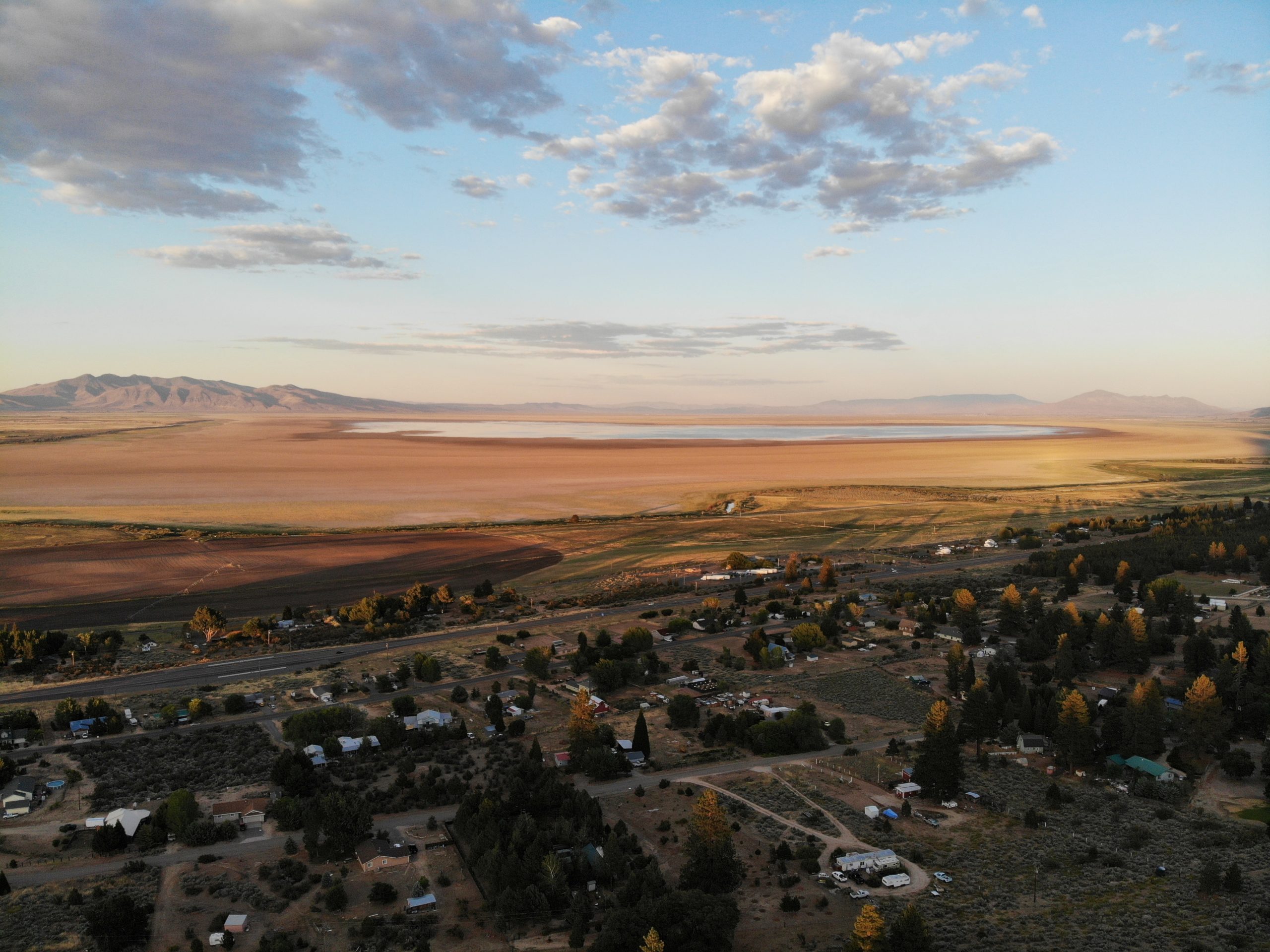
On August 29, 1903 it was reported that Honey Lake had entirely dried up. Since the Anglo settlement of the valley in the 1850s, it was an unusual occurrence. It should be noted that area received abundant winter precipitation. The years from 1907 to 1916 was an extremely wet cycle. In 1911, Litchfield founder, B.F. Gibson proclaimed the lake was so high that it might be necessary in the future to build a canal at the east end of the valley to Astor Pass. and the excess water would then flow to Pyramid Lake at that point. It would not be necessary as beginning in 1917 the region would experience a twenty-year drought in which Honey Lake remained dry all those years.
With Burning Man taking place soon on the Black Rock Desert, the town of Gerlach receives a lot of attention due its close proximity. Some may wonder who was Gerlach.
Gerlach was named for German immigrant Louis Gerlach (1835-1921). He came to the United States in 1853, and in 1855, located at Stockton, California working as a butcher. He would later operate his own butcher shop. Gerlach then became affiliated with the Wagner Meat Company, that raised their own cattle, along with operating a slaughterhouse. This inspired Gerlach to branch out on his own in the cattle business. In 1884, he purchased Granite Creek Ranch, near the present town of Gerlach. As his operations grew, in 1892, he incorporated as the Gerlach Land & Cattle Company. His main focus was northern Washoe County, Nevada. In 1906, Gerlach acquired the Ward Land & Stock Company for $100,000. This included over 5,000 acres, and with it such places as Bare Ranch in Surprise Valley. Thus, a nucleus of an outpost was created at what is present day Gerlach. In 1909, the Western Pacific Railroad built its railroad through the area and established a station at Gerlach, and thus the formation of the community. After Gerlach’s death in 1921, his ranching empire was slowly dissolved.
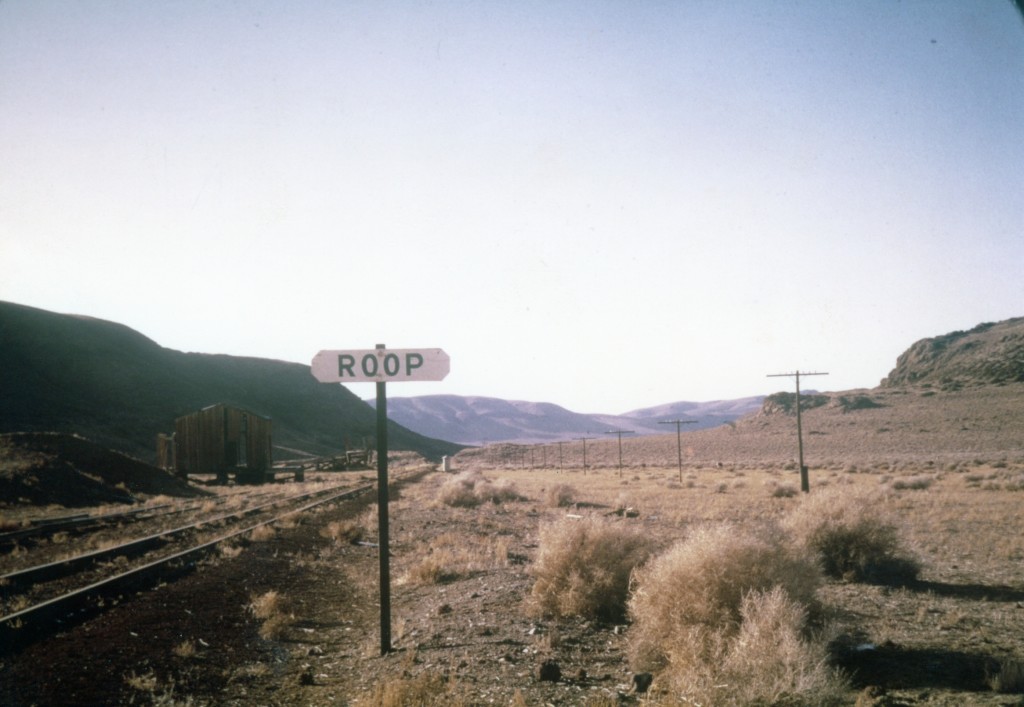
Roop Siding on the Fernely & Lassen Railroad just north of Pyramid Lake, April 1966. Courtesy of Gil Morrill
While yesterday we explored the early day fur trappers of the Hudson Bay Company and others of the 1820s and 1830s in the region there is a geographical feature named for John Jacob Astor. Astor Pass is more like a narrow canyon/valley that separates Honey Lake and Pyramid Lake. By the 1880s, it is well documented as Astor Pass, many attribute it to John Jacob Astor (1763-1848), who was a major American competitor in the fur trade with Hudson Bay.
Astor Pass came into prominence in 1912, providing an easy route for the Fernley &Lassen Railroad into the Honey Lake Valley via Pyramid Lake. In the pass, the railroad established Roop Siding.
While the rails have been removed interest in this locale has not gone by the wayside. In the 1970s, there was considerable interest in diatomaceous earth deposits—remnants of decomposed fish and organic matter of Lake Lahontan. This particular matter, if developed, was to be utilized as fertilizer. Since the early 2000s the area has been studied for potential geothermal resources.
For those not familiar, this was a station along the Nobles Trail and also on the route to the Idaho Mines. You can read previous post here. As I mentioned earlier in the year, I had located some additional information.
In 1851, Eber Bangham (1834-1910) made the overland journey to California from Michigan. In 1852, he returned to Michigan. In 1859, he once again made the journey to California arriving in the Honey Lake Valley in July of that same year. In Bangham’s 1906 biography it states: “On a side trip he discovered Granite Springs and established a trading post with emigrants; the wells which he dug furnished the purest water and were well patronized. In 1862, he divided his interests with his partners and afterward farmed alone on the Susan River.” That area is now present day Johnstonville.
The station to the west of Granite Creek was Deep Hole, several miles northwest of present day Gerlach. Deep Hole Station dates back to 1856 when Ladue Vary located there. In 1861, Thomas Bare in legal proceedings stated he owned Deep Hole Station and the Granite Creek meadows. On September 7, 1861 he sued W. White for $199 for the sale of hay and special damages, i.e. unable to operate the station in pursuit of White. A trial was held in which there were some conflicting testimony. Bare had offered to sell one ton of hay to White for $25. White had hired five men and two wagons to cut and remove the hay which was worth four cents a pound. Of the five men who actually cut and hauled the hay, no one could agree as to how much hay ws cut, citing estimates between 400 and 1,000 pounds. After the testimony Judge V.J. Borrette rendered a verdict in favor of Bare, but only for the amount of $55. Bare, it should be noted moved to the lower end of Surprise Valley, Modoc County in 1864, and the ranch there still is known as the Bare Ranch.
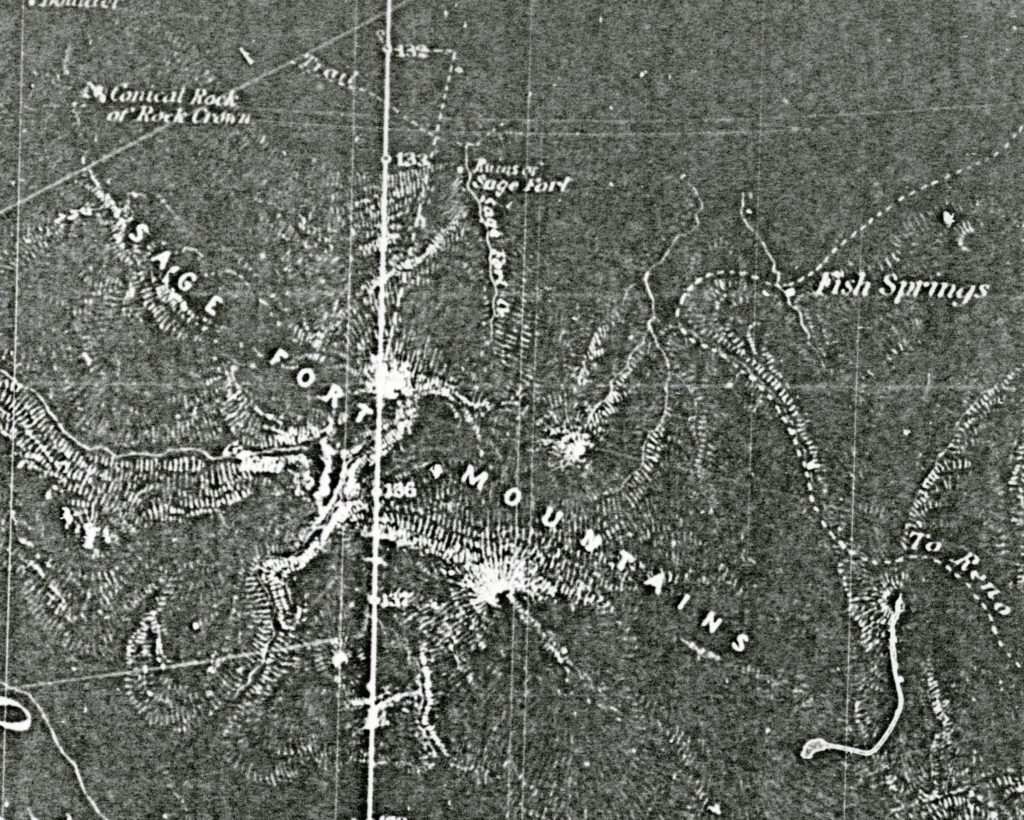
This was an entirely different military encampment from its predecessors of the 1860s. It was never a fort, but a military camp. Military records refer to it as Camp Sage, but fails to provide dates of operation or an exact location, only township and range, the latter of which placed it eastern Honey Lake Valley on the Nevada side. The camp’s sole purpose was a rest stop on the military supply route from Reno, Nevada to Fort Bidwell, California. In June 1872, Perry Jocelyn was in charge of Company D, Nevada Calvary, marched the troops on foot from Reno to Fort Bidwell—a distance of 250 miles. The route went north and east of Reno over the Fort Sage Mountains, to the west side of the Smoke Creek Desert and then criss-crossing the California-Nevada border until it reached Surprise Valley. It was a difficult journey. Jocelyn found that out first hand, on the first day of the seventeen-day march, five soldiers deserted in the middle of the night. An attempt was made to locate them, but they were never apprehended. Unfortunately, Jocelyn’s diary only contained the following notation about the place: “June 2, 1872 – Rev. at 3. First wagon mired within one hundred yards of camp. At 8 o’clock train has not advanced more than one half mile. Cross large hill where it is necessary to double the teams. Newcomb’s ranch just on the other side with lake nearby. Four miles further with still heavier hills, Fort Sage is reached. The whole distance eight miles.”Continue reading Fort Sage, Honey Lake Valley, Nevada→
Soldier’s graves at Smoke Creek, March 15, 1964. Left to Right: Frances Amesbury, Mary Morrill and Gil Morrill. Courtesy of Gil Morrill
One of the interesting endeavors undertaken by the then newly formed Lassen County Historical Society was to locate the soldier graves at the military encampment known as Smoke Creek, just across the Nevada stateline. In 1964, on their first excursion they located it. Over time they decided that something needed to be done as a memorial. In June 1968, they ventured again, this time erecting a large cross on the hillside.
Phil Lord and Bob Amesbury at work putting up the cross, June 1968. Courtesy of Gil Morrill
The small cemetery was established on the hillside across the creek from the camp for the four soldiers who died there while in service. On January 18, 1863, Pvt. John Smith Co C2 Calif Cav died from gunshots at Deep Hole, Nevada, over an argument with his commanding officer Second Lt Henry W. Williams. On November 9, 1863, Pvt. Gustavus W. Platt Co. C2 Calif Cav died of typhoid fever at Smoke Creek. On July 3, 1864, Sergeant William McCoy, age 28, died from an unknown illness. On November 17, 1865, Pvt. David O’Connell Co. B2 Calif. Cav was killed in action at the Pine Forest battle near Black Rock.
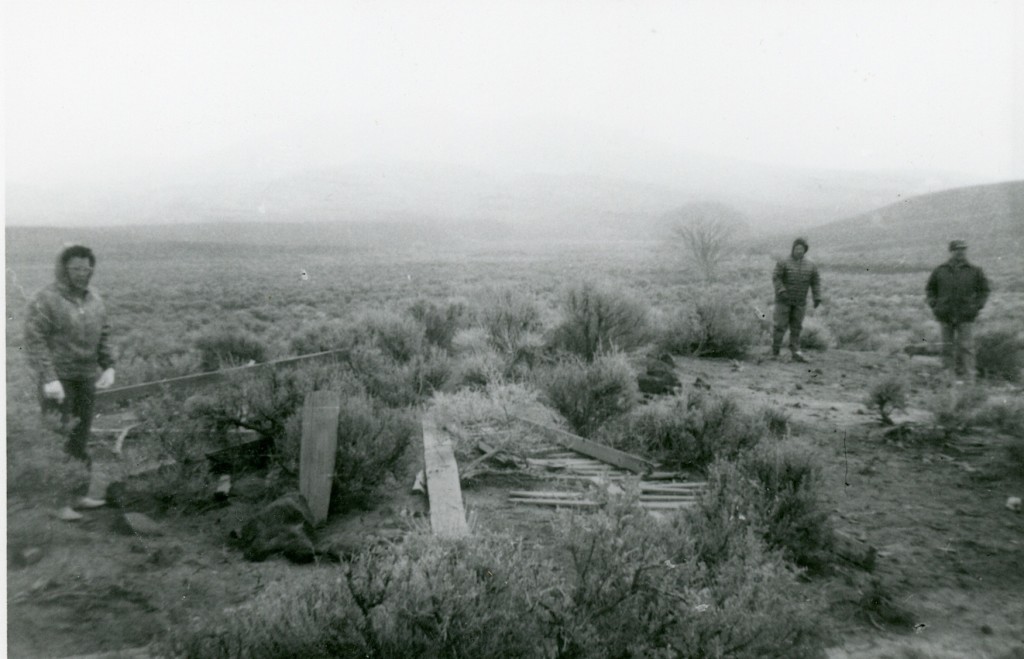
The camp was located near the cottonwood trees seen in the distance. It is located on private property and is now fenced off.
During the 1860s, the United States Military had a major presence in the region, with numerous military camps scattered around the Honey Lake Valley and Northwestern Nevada—one of which was Camp Smoke Creek just over the stateline in Nevada.
Its origins began on November 9, 1862, when Nevada Territorial Governor James W. Nye wrote to Brigadier General George Wright, Commander of the Department of the Pacific, and requested a Company of troops to protects the emigrants from the Indians along the Honey Lake-Humboldt Road. On November 14, 1862, the troops were dispatched. On December 15, 1862, Second Lt. Henry W. Williams arrived at Smoke Creek with twenty-five men and forty days of rations. On March 28, 1864, First Lt. Oscar Jewett, then in command, received orders from Fort Churchill to abandon the camp and to remove all valuable property from the camp as was possible. Continue reading Camp Smoke Creek→