Tag Archives: Honey Lake Valley

Quincy Union Newspaper

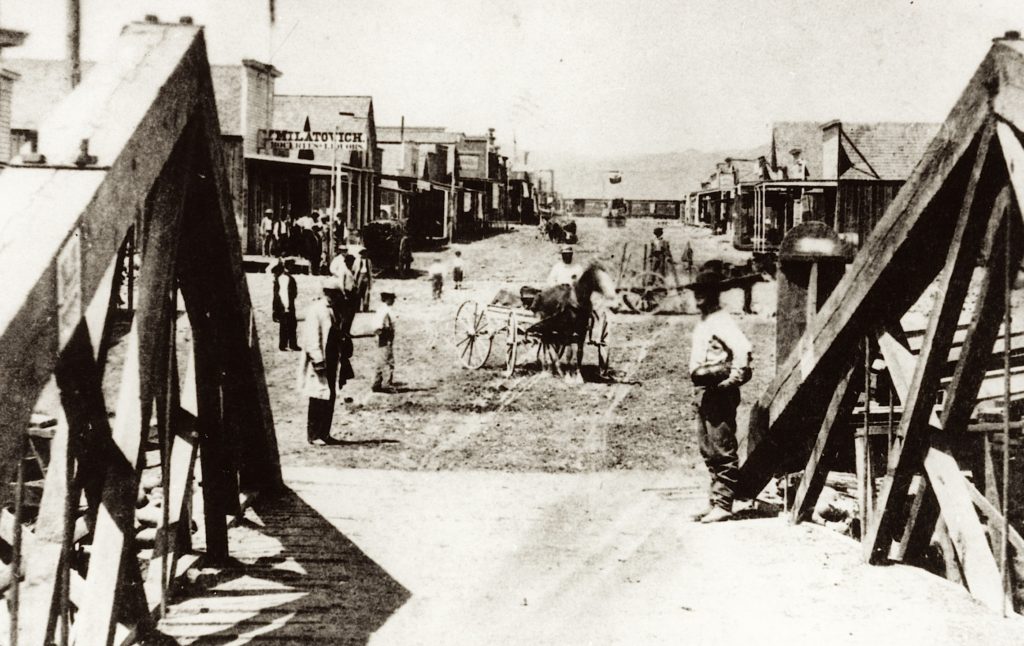
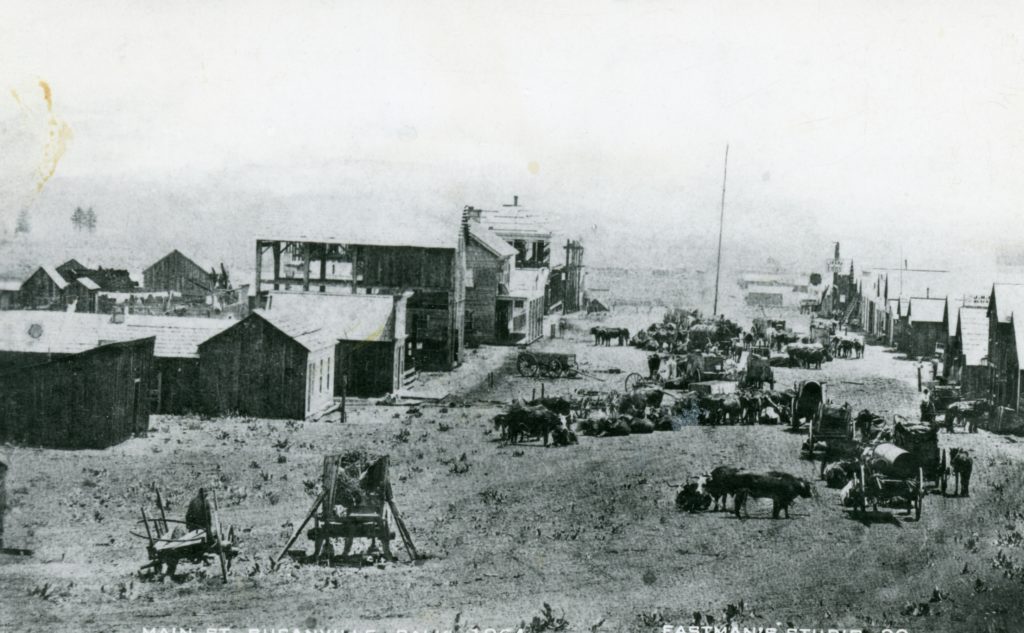
Main Street, Susanville, 1864.

While sifting through some notes, I came across these items from the Quincy Union newspaper of the 1860s. Regional newspapers such as The Territorial Enterprise (Virginia City) to the Marysville Daily Appeal provided coverage of the Honey Lake environs. So here are some tidbits.

January 3, 1864 – They have a rabbit mine at Honey Lake. On one day 400 of those animals were sent to the Virginia City market.

January 30, 1864 – Hay is selling for $80-$100 per ton in Honey Lake. There is no hay in Sierra Valley.

March 5, 1864 – The farmers in Honey Lake are busily at work ploughing, sowing, repairing and improving their ranches.

September 17, 1864 – The new jail in Susanville is in course of erection and when completed will be an ornament to the town and very convenient. It is built of Roop granite found in the quarry near the town.

September 15, 1866 – Post Offices at Black Rock. Post offices have been established at Spring City and Hardin City. W.H. Vanalstine is appointed postmaster at Spring City and Charles Nixon at Hardin City. This will be of a great accommodation for the Black Rockers.

29 September 1866 – On the Way. Alvaro Evans of Long Valley has a quartz mill on the road for Black Rock. They expect to have it put up and running by the first of November. (Note: This mill was moved to Hayden Hill in 1871)

Tim
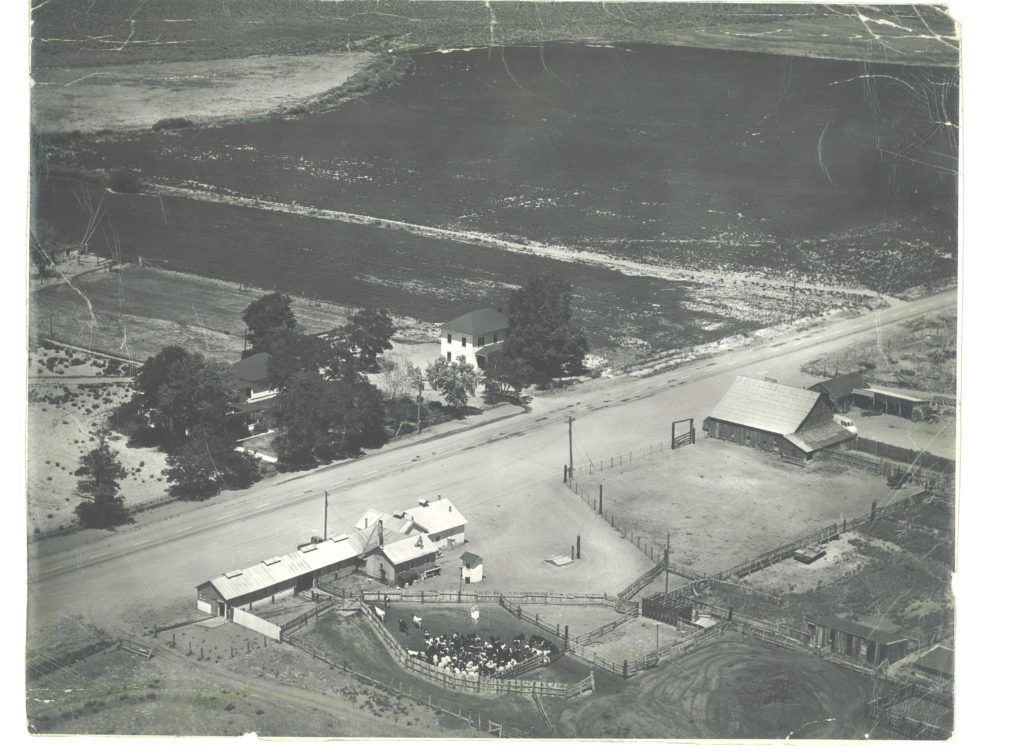
Where Are We —Gibson/Haley Ranch

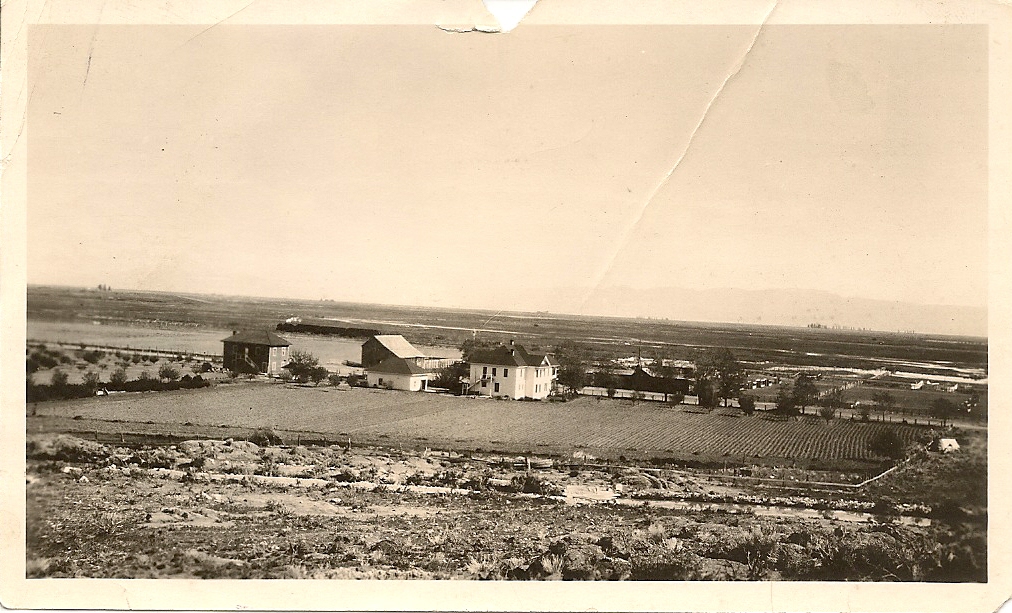
Gibson/Haley Ranch, 1957—John M. Gibson

In 1866 by Andrew Litch settled in the Honey Lake Valley having abandoned the  Granite Creek  Station. In 1868, Litch and Thomas J. French purchased the Shaffer Brothers Ranch (known today as Mapes). In 1874, the two men dissolved the partnership and split the ranch. In 1883, Litch moved to Reno, but kept the ranch, renting it out.

The Gibson/Haley Ranch, near Litchfield—John Gibson

In 1895, B.F. Gibson married Clara Litch, where he took over his father-in-law’s ranch. Gibson continued to make improvement and acquired additional property near Wendel known as the Purser Ranch. Gibson was also the main beneficiary of Ward Lake for a water supply. Descendants of the family continued to operate the ranch until 1975, when it was sold.

Support

Poison Lake, Lassen County

Poison Lake
Poison Lake, 1916

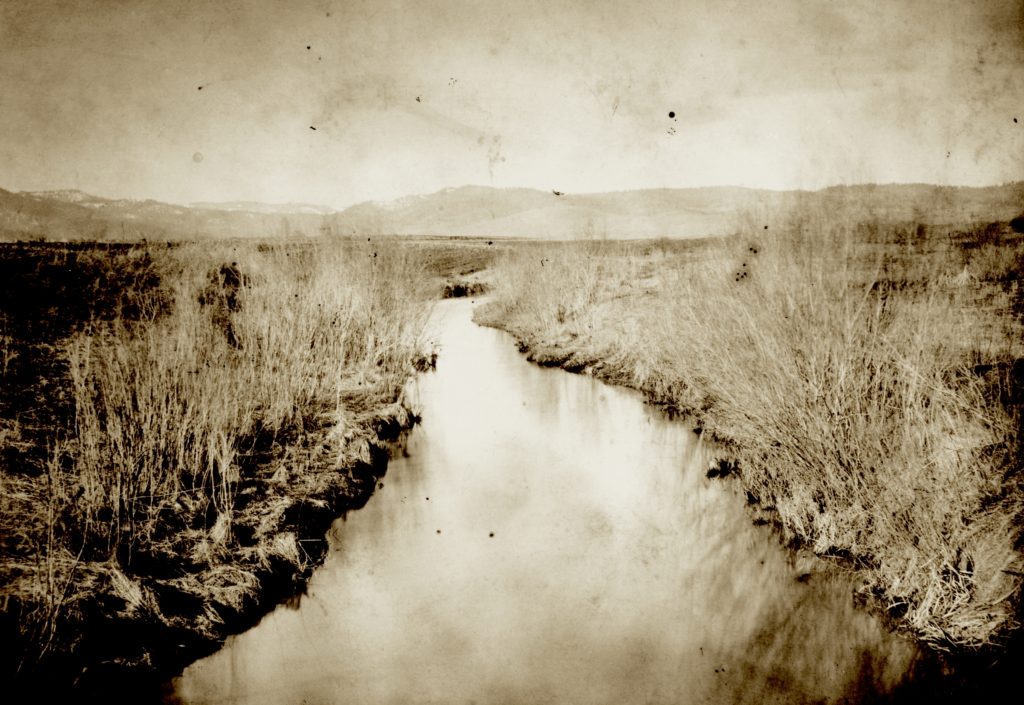
A shallow lake, along Highway 44, with water that was found to be unfit to drink by the emigrants on the Lassen Trail. The travelers also found that Lassen’s Trail was not “fit” for travel either. According to the journal of Gorham Gates Kimball who was driving sheep to Idaho in 1865, it mentioned that Poison Lake ‘was so named from the effect of the bites of small red spiders which frequented the surface of the water.’ Apparently, merely washing your face and hands was enough to receive bites and experience red inflammation.

In 1916,  William L. Wales, an engineer hired by the Honey Lake Valley Irrigation District, took the above photograph, as part of his exhaustive study to seek water. He proposed diverting annually 33, 962 acre feet from Butte Lake, (no one had ever filed a water right claim to it) . A canal would be constructed from Butte Creek to divert it to Poison Lake, thence onto to Pine Creek to Eagle Lake, through a tunnel there and onto the Honey Lake Valley. Very clever. However, the district was plagued with so many problems in the beginning that it never went past the initial study phase.

Spread the word, and encourage a friend to subscribe

Before Reno—Fullers Crossing

Virginia Street Bridge, Reno—Nevada Historical Society

For over a century the crossing of the Truckee River at the approximate location of the Virginia Street Bridge had always been attributed to Myron Lake back in 1861.  Tucked away in the archives of Lassen County, would require the earliest history of Reno to be revised.

In the fall of 1859, Charles William Fuller built a toll bridge and small hotel at the approximate sight of today’s Virginia Street’s bridge in what would become the nucleus of Reno. Fuller saw the opportunity as the farmers/ranchers of Honey Lake & Sierra Valleys were eager to feed the miners of the newly discovered Comstock.  On September 28, 1861, Fuller traded this property for a ranch in the Honey Lake Valley  with Myron Lake. In 1868, Fuller filed for bankruptcy. In Schedule A of that proceeding provided all his activities until that time. The trading of the property is recorded in Book A, Page 27, Deeds of Lassen County.

Support


Uniform Wage Set – $2.50 a Day

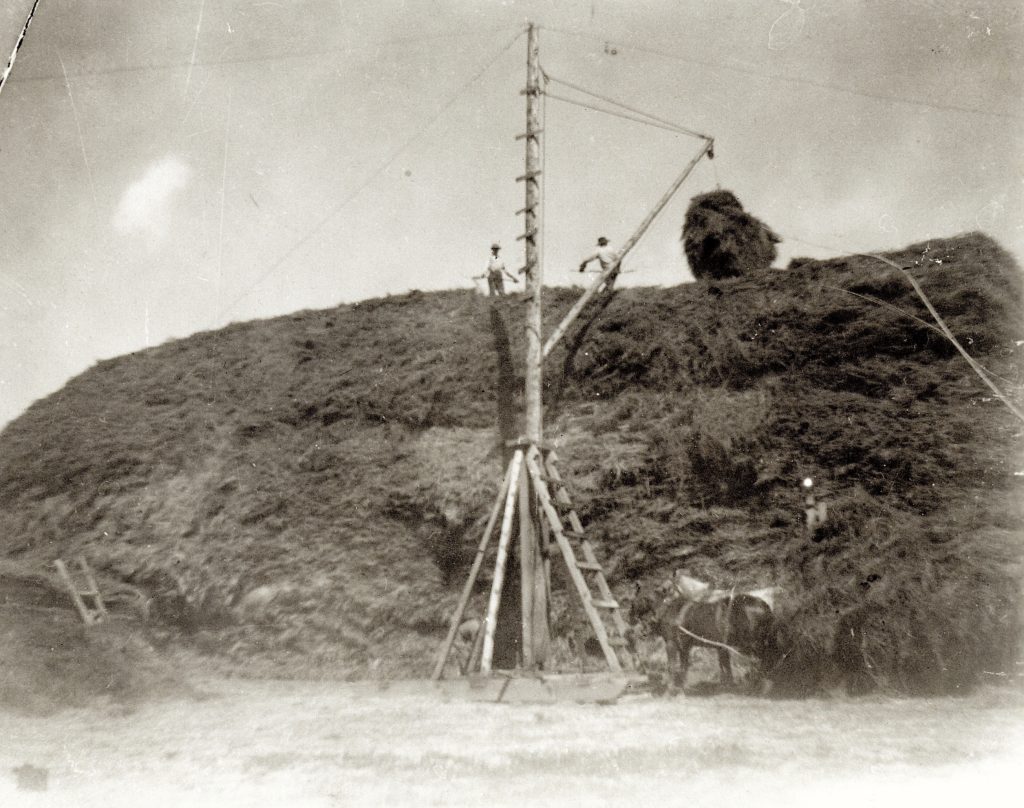
The Tule District, Honey Lake Valley was best known for many years it hay production. Titherington Ranch, 1906—Betty Gorbet

In June 1931 fifty-one farmers attended a meeting at Standish to discuss wages to be paid to workers during haying season. There was no uniform wage rate. Some paid $2.00 a day, others $3.00 day.  After considerable discussion it was agreed to pay $2.50 a day plus board. Another issue widely talked about, but there no consensus was reached was the amount of hours. However, just agreeing on a uniform wage was a major milestone.

Tim

The Vanishing Windmill

January 26, 2020

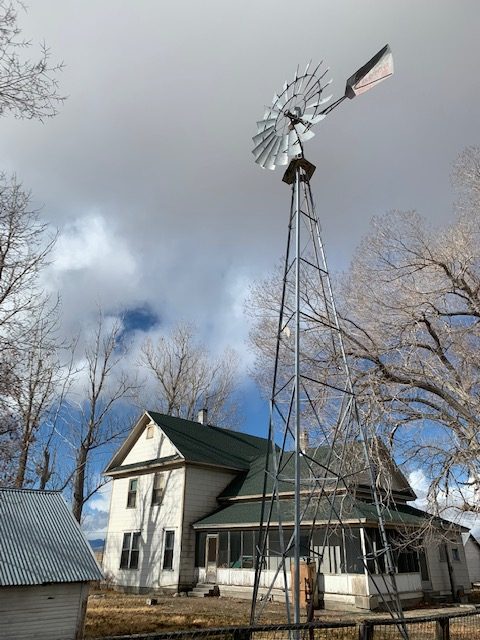
Bringing electricity to the Honey Lake Valley was a long, slow process that began in the 1920s. When power finally did arrive, it brought about the slow demise of the windmill. Phil Hall (1909-1996) and a native of Long Valley,  commented that there were at least fifty windmills between Susanville and Doyle. Hall’s statement came from a 1989 conversation with another old time rancher, Claude Harwood. In response to Phil’s comment, Claude stated that they did not have power from Buntingville to Milford until 1938. Claude continued after that, people stopped using them. Phil added the abandoned windmills also became victims of wind, blowing them down.

Subscribe

Placer Mining, Honey Lake Valley

Honey Lake Valley, 1898–Betty B. Deal

Placer mining in the Honey Lake Valley was short-lived and mainly confined to the 1850s. It should be noted that the gold discoveries of the 1850s were of placer nature—gold nuggets found in streams and ravines. When Peter Lassen and Company discovered gold in Hills Creek in 1855, they constructed a ditch to assist in their efforts. By the end of June they had to abandon their work when the creek went dry. By 1856 with a major influx of miners in the region, they would experience the same, and placer mining was a spring time occupation.

In August 1858, Quincy’s Plumas Argus reported on this condition. “We are informed that everything is quiet at Honey Lake. A silver mine is being opened there.  Several companies are at work on the vein, which has been known to exist for several years, although nothing definite is yet known as to the extent or richness. Placer diggings have been discovered near the lake that are known to be good. If they had water on them they would pay from ten to twenty dollars per day to the hand, but there is no capital there to invest in ditch property.”

By 1859, placer mining in the area had ended as quickly as it began., since the easy pickings had been done. The focus would turn to lode operations, i.e., hard rock extraction.

Spread the word, and encourage a friend to subscribe

Pyramid Lake Task Force

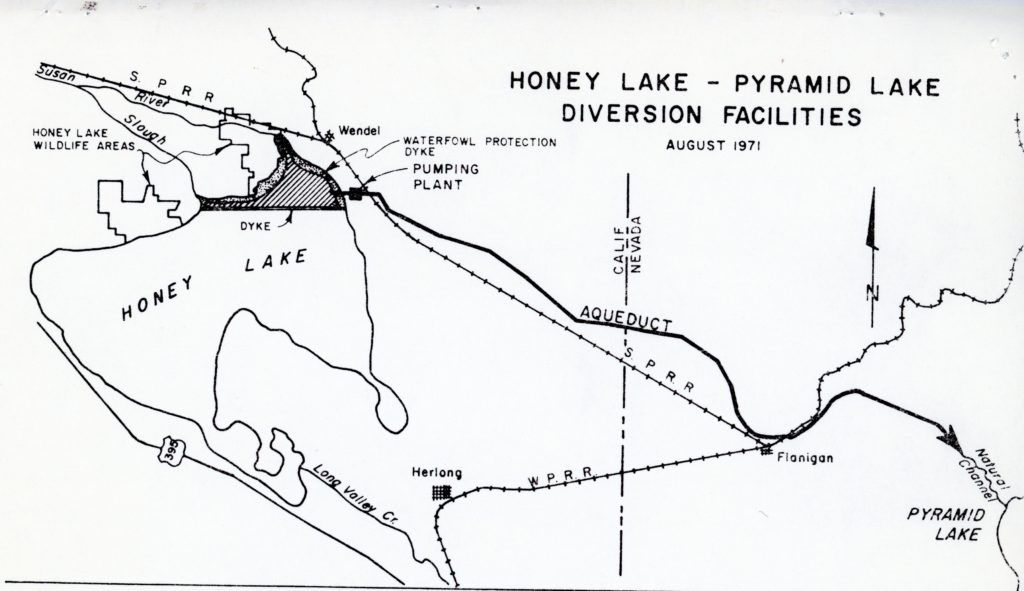
In 1969, the Pyramid Lake Task Force was established to seek solutions concerning the shrinkage of Nevada’s famous desert lake. In 1971, the Task Force submitted a proposal to Lassen County officials for their consideration. They obliged. The plan called for the exportation of 50,000 acre-feet of Honey Lake water to Pyramid Lake. The two lakes, both remnants of Lake Lahontan, are relatively close, though Honey Lake is 190 feet higher in elevation. It was their intention to dry up Honey Lake, except in the northeast corner. There a 4,700-acre freshwater reservoir would be created for a wildlife sanctuary. Adjoining it would be a holding reservoir with a capacity of 27,000 acres. A pumping plant would be built near Amedee, where the water would flow through a twenty-four mile long aqueduct to Pyramid Lake. The Task Force considered this plan the most feasible of all considered. Construction cost was estimated at $12 million, with an annual operating cost of $200,000. This did not include any litigation fees with affected properties for rights-of-way or damage payments to lakeshore owners. The adverse effects of Honey Lake being permanently dry drew heavy criticism from the local residents. The lake is enjoyed for its aesthetic beauty when full. When the lake is dry, it is a scene of numerous dust storms. Opponents were also concerned with the loss of humidity and its effects on agricultural crops. At a November 8, 1971 public hearing the Lassen County Board of Supervisors passed a resolution opposing the project. After all these years later, the problems with Pyramid Lake’s water level still has not been solved.

Donate/Subscribe

Buntingville Improvement Company

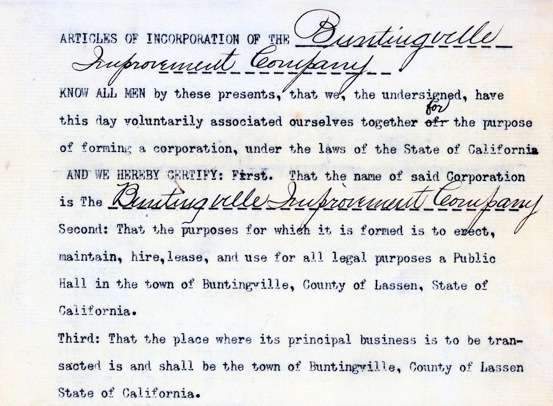
A portion of the Articles of Incorporation

While Buntingville, just south of Janesville, appears today to be a mere wide spot in the road, it was not always that way. Like so many communities the residents desired to have a public hall. On January 1, 1911 five residents—Chester Toombs, Edwin Jellison, Theo. Gross, W.E. Agee and Birt Hostetter—led the movement by incorporating as Buntingville Improvement Company. Their goal was to raise $2,000 by selling stock with a par value of $5.00 each. The men quickly learned like those in neighboring communities, there just was not enough support to make a go it and the venture faded as quickly as when it was first proposed.

Support