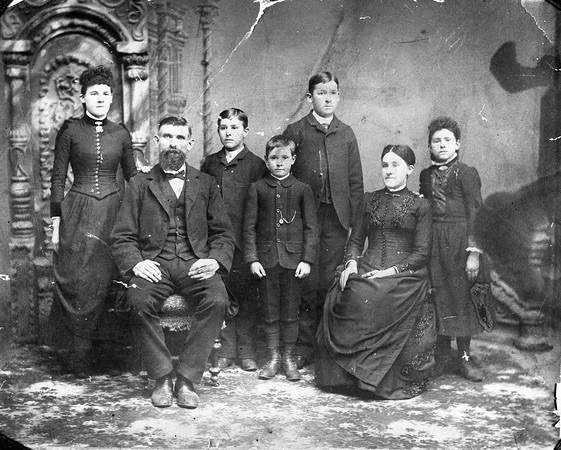
Andrew Litch Family. Left to Right: Clara, Andrew, Thomas, George, Fred, Mary (Grass) and Minnie–Courtesy of Erma Gibson Haley
In 1850, Andrew Litch (1883-1906), a native of Germany, arrived in California. During the 1860s, he operated a trading post, the Granite Creek Station. In 1866, he abandoned the station and moved to the Honey Lake Valley. In 1868, he entered into a partnership with Thomas J. French. That year, they purchased the Shaffer Brothers Ranch (known today as Mapes) for $2,500.. In 1874, the two men dissolved the partnership and Litch received the western part of the ranch. In 1883, Litch moved to Reno, Nevada, though retained ownership of the ranch and leased it.
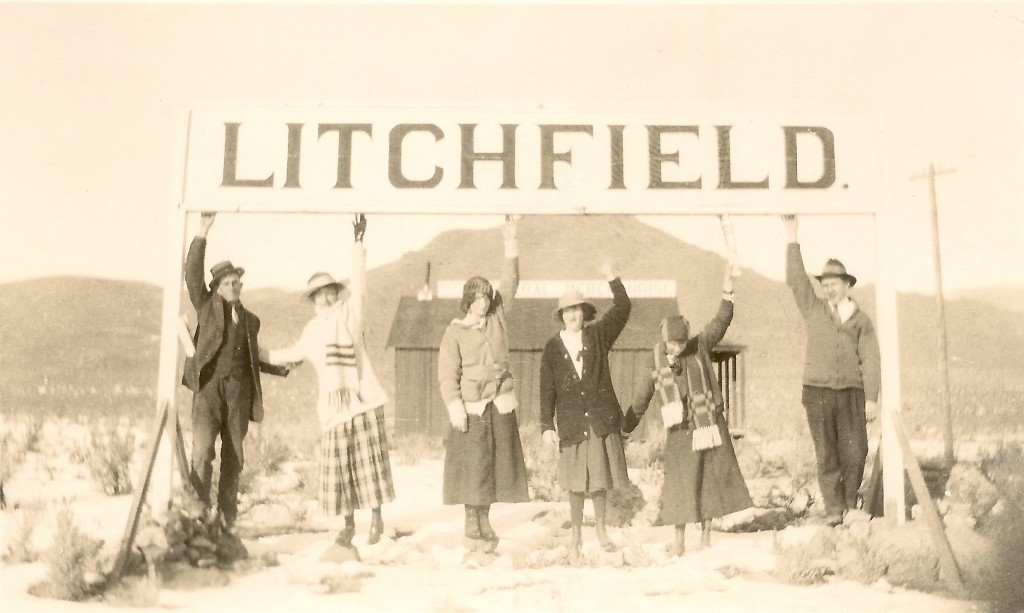
A town is born, Litchfield. Courtesy of John M. Gibson
In 1895, B.F. Gibson married Andrew’s daughter,Clara Litch, and he took over his father-in-law’s ranch. In 1912, construction began on the Fernley & Lassen Railroad that went through the Litch property, now owned by Gibson. On January 8, 1913, Gibson had subdivision created for a new town, served by the railroad. He named it Litchfield, in honor of his father-in-law.
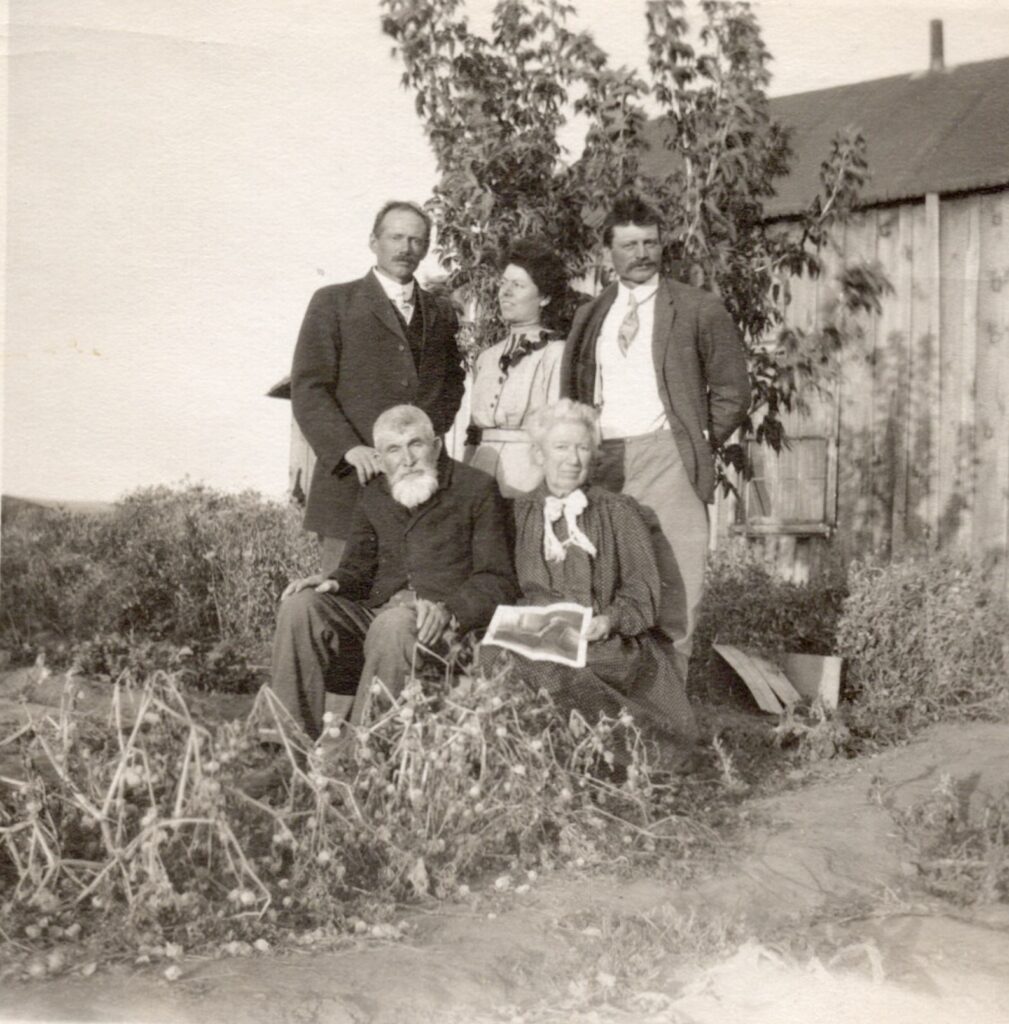
Mark W. Haviland. Courtesy of his great-grandson Allen
Mark W. Haviland was one of the many early Honey Lake Valley settlers of the 1850s who remained awhile, then moved on to the proverbial greener pastures. For him that was Paradise Valley, Nevada where he died in 1894. Continue reading Mark W. Haviland, An Early Honey Lake Settler→
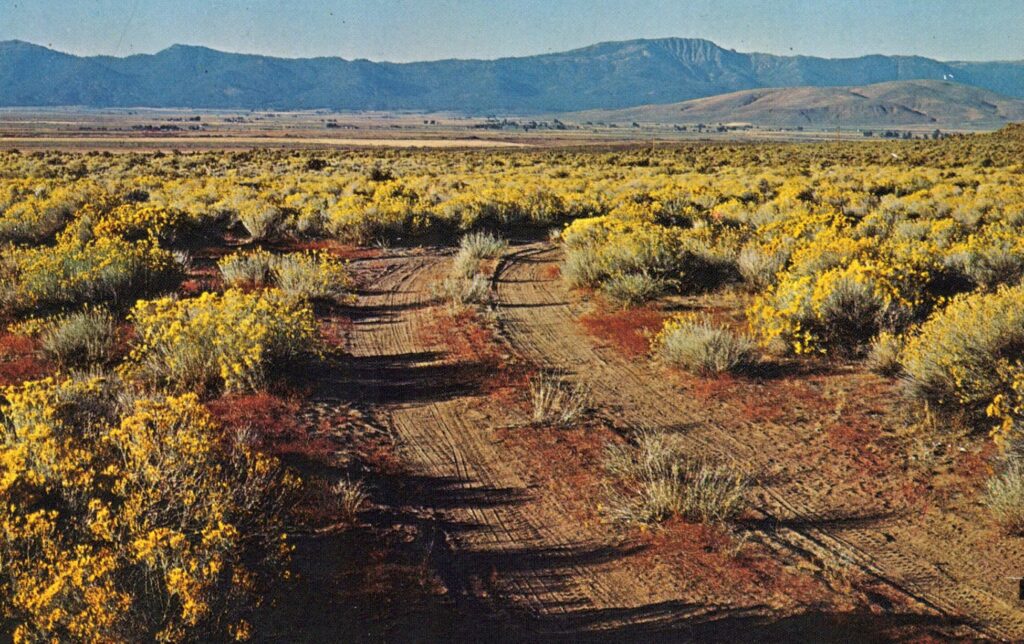
The above is an Eastman Studios postcard that I happen to like. September is one of my favorite months of the year. The weather is normally ideal, warm days and cool nights.
It also a harbinger of of upcoming fall colors. The most notable is when rabbit brush (Ericameria nauseosa) starts bloom. For me it is a visual delight. However, for others with allergies it is not pleasant experience.
Caudle Famiily. Seated Alfred and Mary Caudle. Standing Carl, Mamie and Marvin Caudle Taken at Mamie Caudle’s homestead, June 1912.
In 1906, Marvin Caudle located on a homestead some ten miles east of Amedee. In time, his parents, brother and sister would locate there. This later became known as the community of Stacy. All five family members are buried in the nearby Honey Lake Cemetery.
The Zarbock Brothers on their desert homestead near Stacy. Courtesy of Pam Zarbock Bell
In 1910, the Nevada Sugar Company of Fallon, Nevada came courting Honey Lake Valley farmers in the Standish district, as well those homesteaders on the east side of Honey Lake to plant sugar beets. One of the reasons, was the Nevada Sugar Company was in the midst of constructing a factory at Fallon.
As an enticement the company stated it would build a second factory at Standish if production was successful and needed transportation facilities. In 1912, with the announcement of Fernley & Lassen Railroad to be constructed through this section of the Honey Lake Valley solved that transportation issue.
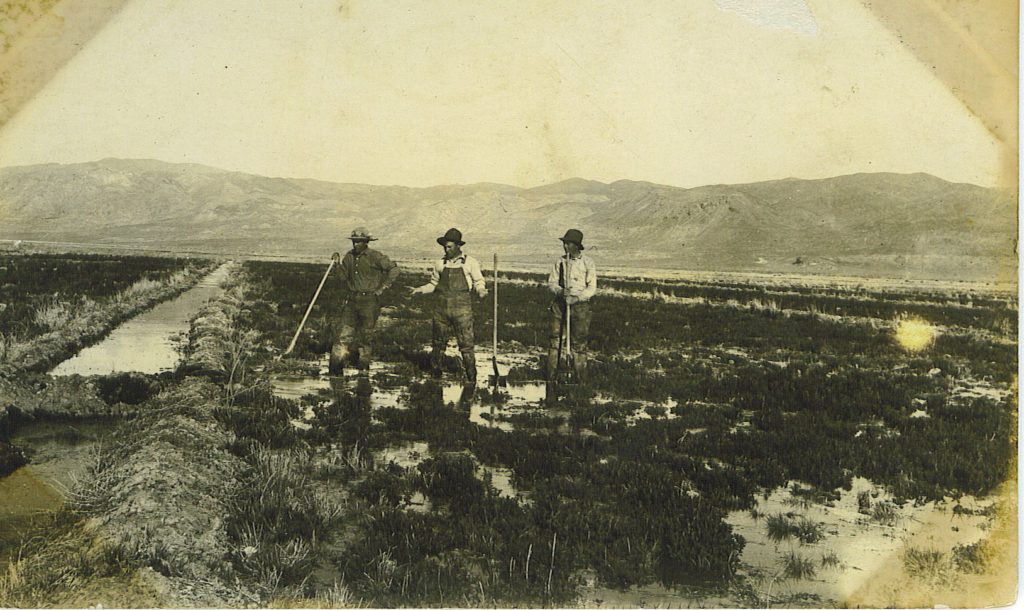
It should be noted that in 1911 was the first irrigation season of the Standish Water Company’s pumping plant on Honey Lake’s eastern shore. In that year they provided water for 1,000 acres that was planted in sugar beets, with the Nevada Sugar Company providing the seed. No one locally knew anything about growing sugar beets, but they learned quickly. One of the biggest problems encountered with beet production was the amount of labor required. The problem was compounded as there was a local labor shortage, and then there were those who did not want to work in beet fields. To alleviate the problem 25 Japanese laborers were brought in to assist. Their tenure was brief, even though it was reported they worked twice as fast at a cheaper price.
There were two other problems that ended the experiment. First there was not an adequate water supply and the beets were substandard. It was not only a problem locally, but in Fallon as well for in 1917 the beet factory there closed.
In the spring of 1914, Lassen County Deputy Horticural Commissioner, L.W. Boggs, paid the community of Doyle a visit. George Thompson had planted 1,000 grape vines the previous year. Thompson informed Boggs that he intended to plant 4,000 grape vines for 1914. His neighbors were interested in doing the same. In addition to Thompson’s visit Boggs complimented the citizens of Doyle for grading the town’s streets and planting shade trees along them.
The following year the Sunnyside District near Janesville was promoted as an excellent wine producing region. There were no takers. In the meantime, Thompson’s grape vines did not work out. However, Ben Gibson of Litchfield was successful in growing commercial Concord grapes and more notably watermelons.
These springs in eastern Honey Lake Valley and near the Nevada border are quite unique. They are an ancient spring dating back to the time when the area was covered by Lake Lahontan in the Pleistocene epoch.
The second reason is it is a warm water spring with a constant temperature of 86F. The springs supports two kinds of fish. First is the Lahontan tui chubs. This, of course, is rather remarkable that the fish have adapted over the years to thrive in constant warm water in a confined space. Water from the spring then goes underground and re-surfaces 100 yards distant, maintaining a constant cooler temperature at 76F. At this point, again, which is also unusual, is found the Lahontan speckle dace, that was to be on the endangered species list. The Lahontan speckle dace in this spring is no more. In the 1990s, the spring used as a fish farm. Some one planted exotic fish in the springs channel, thus caused the speckle dace there to be extinct.
I found the newspaper article of interest from the Lassen Advocate May, 15, 1914 – Here From High Rock. Jas. Mapes and Jas. Dudley were there from High Rock last Monday. Mr. Mapes was proving up on his desert land claim before the officers of the land office. Jimmie is very enthusiastic over prospects down there, and is a very busy man. He says he has the dandy water system of the county, and the water problem is one which will not be a great worry him in the future. He has a chain of three dams, and these, by giving out their waters one at a time as needed, will probably prove sufficient for all purposes. In addition, however, he is contemplating building a dam to impound the waters of the one spring, which will be a valuable addition to his water supply.
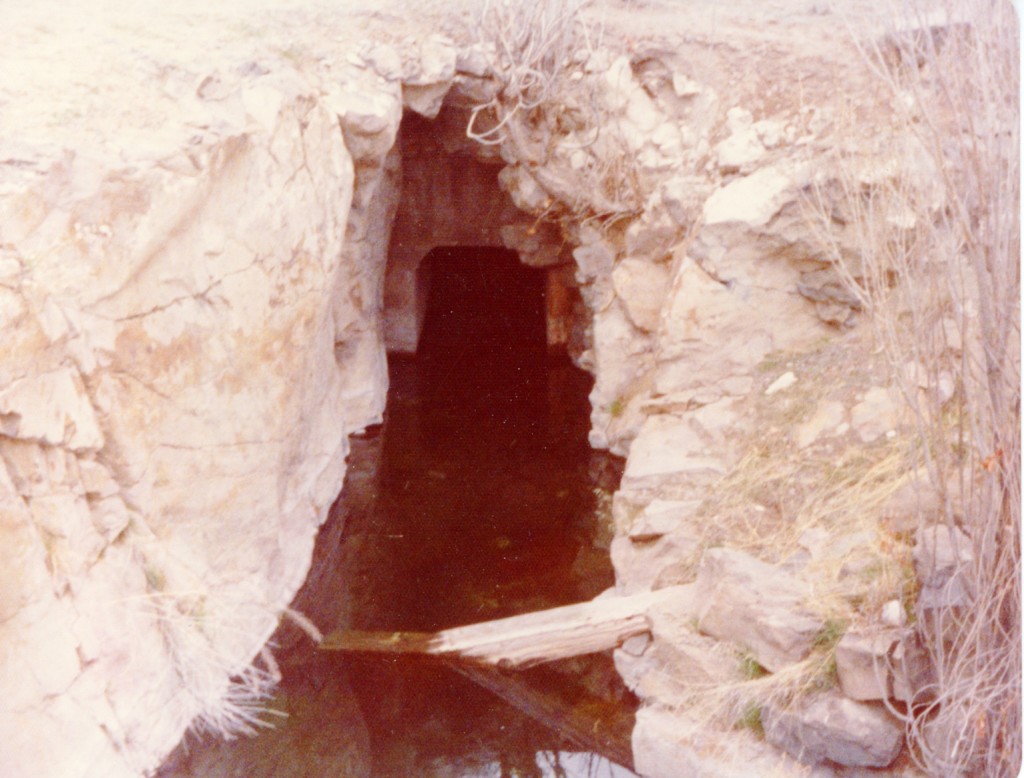
A portion of the tunnel outlet of High Rock Springs. April, 1975
It should be noted that in the 1920s, William Dicting was hired by the Rees Jenkins to develop the springs. He spent eight years to hand drill through the rock to develop the water tunnel to increase water flow.
High Rock Ranch in eastern Honey Lake Valley was a popular gathering place for rodeos in the late 1800s. Courtesy of Madelyn Mapes Dahlstrom
The High Rock Ranch in eastern Honey Lake adjoining the Nevada state line, owes a lot of its existence to the springs. Water in the desert makes a big difference.
Interesting enough, on February 7, 1862, U. Johnson Tutt laid claim to this remote outpost. Tutt made no improvements and abandoned his claim. In the late 1860s and 1870s, High Rock was a scene of rodeos, not quite the same as our modern day version. During this era, very few ranches had fences. It was customary, especially in the winter months to let their cattle and horses roam in search of feed. Each spring several localities were chosen for sites for round-ups and rodeos, and High Rock was one. Once the stray livestock were herded to a specific location, they were separated and branded. Continue reading High Rock Ranch→
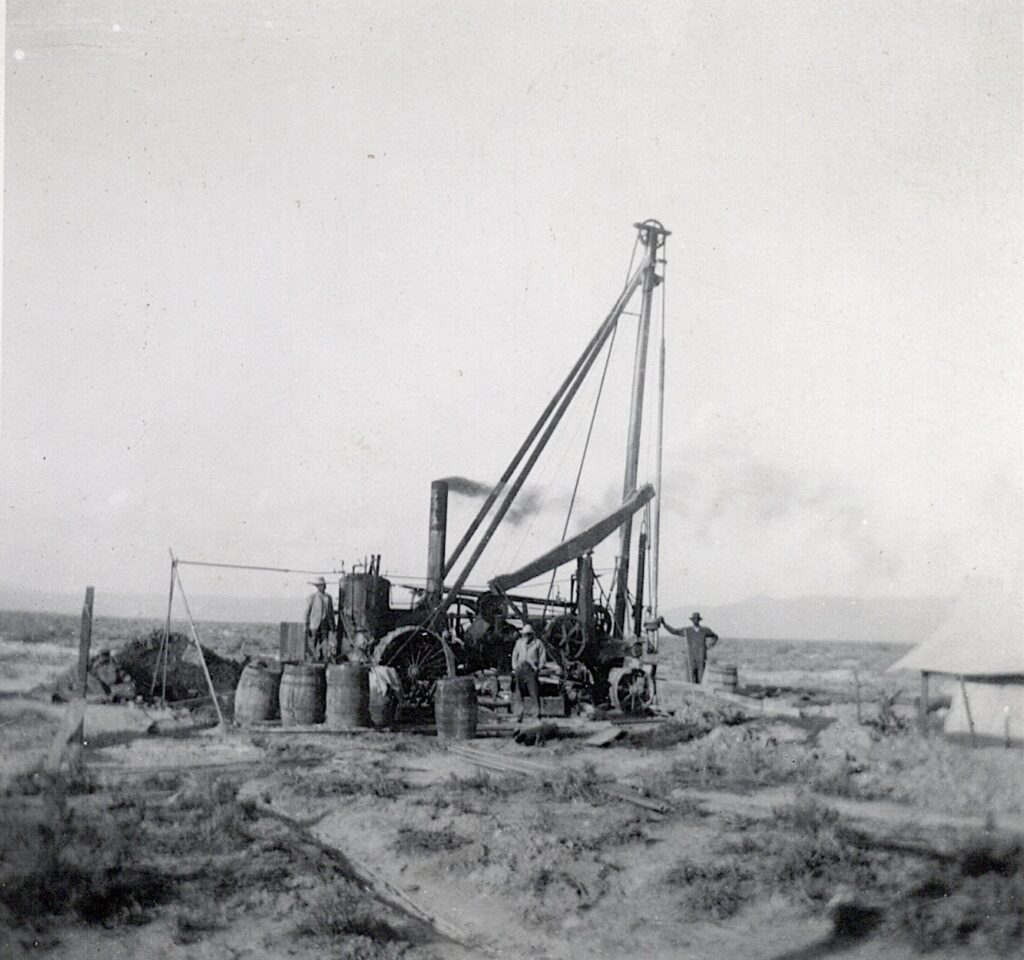
Caudle & Warden drilling a well for the Western Pacific at Calneva.-C.R. Cudle Collection
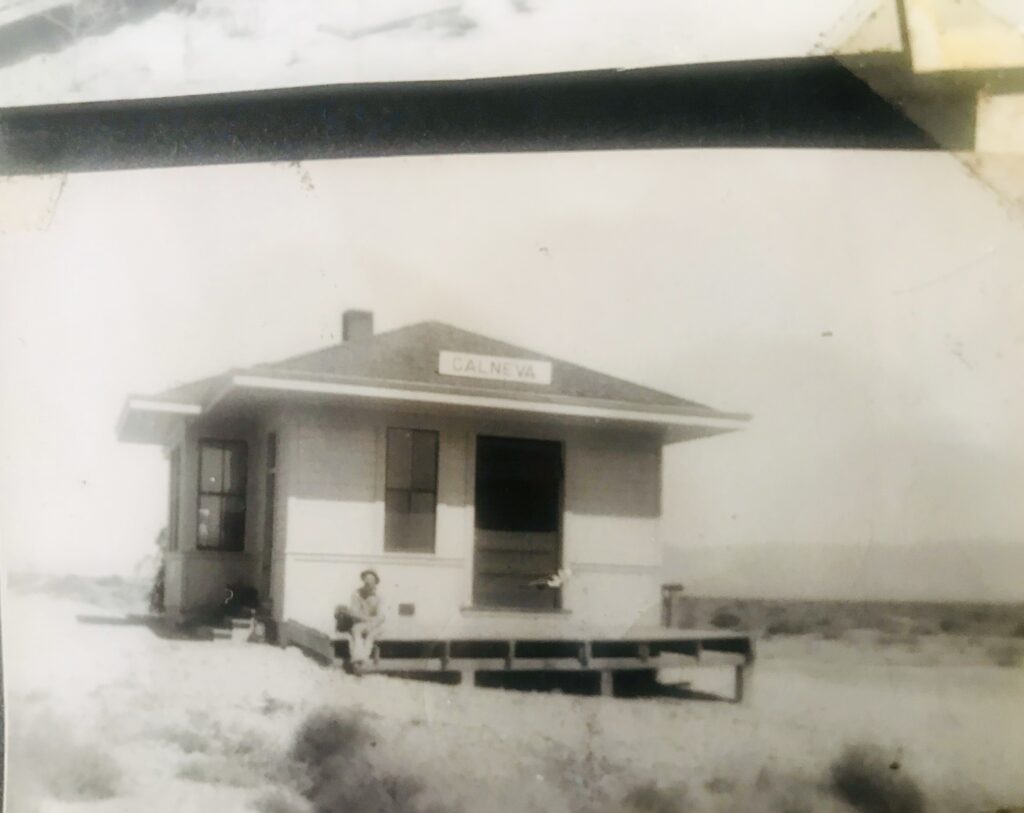
Calneva was located in the eastern Honey Lake Valley with a close proximity of the California and Nevada border, approximately six miles east of Herlong. In 1910, the Western Pacific Railroad established the Calneva Station. During the 1910s, this area experienced a great deal of homestead activity. Individuals were lured there by a promise of water from the South Lassen Irrigation District, that planned to divert water from the Little Truckee River via Long Valley Creek to irrigate the desert lands of eastern Honey Lake Valley. Those and other proposals never materialized.
Calneva Station-Courtesy of Russell Umbraco
In 1921, the Western Pacific Railroad received permission from the California Railroad Commission to abandon the station. They cited in 1920, only 61 passenger tickets were sold and freight revenue was $435.01–the station’s total profit for that year $117.27.
In 1912, F.T. Cromwell, a land speculator arrived in the Honey Lake Valley. Using other people’s money he laid out a town where the Western Pacific and NCO Railroads crossing. The site is the current town of Herlong. Amidst all the hoopla, there was a drama to be found. The construction of the Cromwell Hotel and other improvements had to be abandoned as the unpaid workers clamored for payments.
Court judgements started accruing. The finale was on February 7, 1914, a court auction was held at Cromwell. Nearby Stacy resident, Ferdinand Zarbock reported that everything tangible to the townsite of Cromwell was sold under the hammer on that date. The frame of 40 x 70 ft. hotel building, some loose windows and doors and lumber all went for $100 to C.W. McQueen. Some eight inch well casing sold for $5 to F. Zarbock. The proceeds barely covered the cost of the auction.