Tag Archives: Agricultural

Stacy

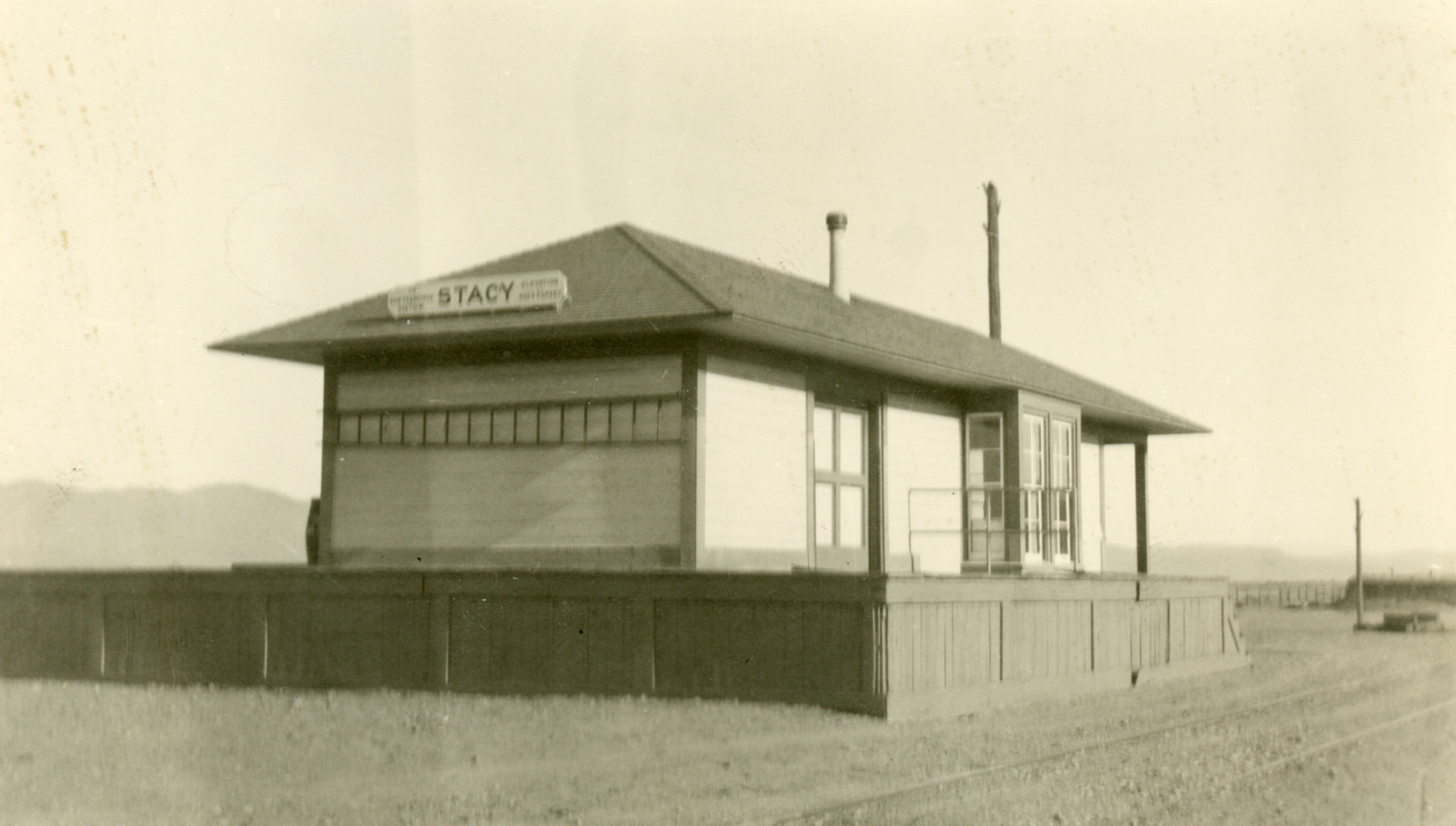
Stacy Depot
Stacy Depot. The town was named for Stacy Yoakum Spoon, wife of Grover Franklin Spoon, one of the town’s developers and its first postmaster.

Once it became known that the Fernley & Lassen Railroad would be constructed through the Honey Lake Valley, it made the region a virtual paradise for real estate promoters. Three towns were plotted out—Leavitt, Litchfield and Stacy, the latter being in the eastern part of Honey Lake Valley between Amedee and the Nevada Stateline.

On April 19, 1913, the Lassen County Board of Supervisors approved the Stacy townsite. The town’s founders, the Spoon Brothers—Frank and Andrew—and Doctor B.B. Bolton envisioned great possibilities, such as the development of a major shipping facility for the region’s start up sugar beet industry. Prior to the railroad development, numerous homesteaders had arrived in part of the dry farming experience, and that of the Standish Water Company’s reclamation plan to use water from Honey Lake to transform the area into a major sugar beet region.

Support this site and Subscribe today!

Brockman Ranch

Brockman Ranch
The barn is far to the left, as the Brockman Ranch appeared in 1903.

I realize that the Edsel Dealership was to be today’s topic, but a recent event prompted the change. On Wednesday afternoon, April 29, the old Brockman barn on Johnstonville Road went up on flames. In 1864, William Brockman and Jurgen Jensen were partners in a blacksmith shop in Susanville. A few years later they dissolved it. The two men located on nearby ranches on Johnstonville Road. After a 1947 suicide of a Brockman family member that occurred in the barn, the ranch after three generations of ownership was sold.

Don’t forget to look at the Subscribe feature.


Brand Project Update

Hulsman
Hulsman Ranch advertisement

Progress got stymied a bit, due to my knee injury. While my archives contain a wealth material, there is always research to do.

It was interesting to review Book A of Brands, Lassen County. The first brand recorded was for Thomas Watson on October 20, 1864.  The John Theodore brand JT was recorded on May 23, 1889 and never changed for over three generations and appears on the wall at the Pioneer. The same can be said for Hulsman Ranch brand though it was not recorded until 1917, when the State of California began enforcing the recording of brands.

Additional brands have also been included in the original list: George and Mayda Elledge, Hostetter & Johnson, Abner McKenzie and Coit Stone.


Leavitt City


Stock corrals at Leavitt, circa 1922.

In the fall of 1912, Benjamin H. Leavitt proposed the town on his original ranch. Leavitt wrote to his granddaughter, Edith Elledge, of his intentions: “I am going to cut the old ranch up into small tracts and sell it off in ten and twenty acre tracts . . . I am also building a road down from Rice’s Canyon, you know that is directly north of the town of Leavitt, to connect with all the northern trade clear out to Big Valley. The R.R. Co. have agreed to put their stock yards there. I have given them the land for the stock yards. I am also going to extend the road through the ranch to intercept the Janesville Road near Billey Indian. All the merchants of Janesville have agreed to order their good shipped to Leavitt which will make it one of the largest shipping points on the Fernley & Lassen.”

In addition, Leavitt offered railroad officials land if they would construct their roundhouse there. That proposition did not occur as Susanville’s business community convinced the railroad to locate that operation in their town. “The City” consisted of only the store, a few dwellings, and several large corrals that held livestock for shipment on the railroad.

Yet, years later, one could say a city of sorts of was built just north of Leavitt, the home of the California Conservation Center and High Desert State prisons.

Don’t forget to examine the Subscribe feature.

Said Valley Reservoir

Said Valley Dam
Collapse of the Said Valley Dam, May 8, 1938. Courtesy of Betty Barry Deal

In September 1885, James W. Shanklin constructed the first reservoir for irrigation and stock purposes at his ranch in Grasshopper Valley. That dam was 25 feet high and 300 feet across. Over the years it had numerous owners. In 1934, it was purchased by George Heath, who became the owner of this reservoir as well as one on nearby Slate Creek. As early as 1929, the State Department of Water Resources stated neither dam was in compliance and requested that spillways be constructed for each reservoir. The winter of 1937-38 was one of the wettest on record for the 20th century and, in Susanville, 33.68 inches of precipitation was measured. On May 8, 1938, the dam at Said Valley breached and caused considerable flood damage. On August 24, 1939, Heath sued Percy L. Castro for $50,000 in damages that were caused by dam failures. It was Heath’s contention that, since Castro leased the reservoirs and his Grasshopper Ranch, it was his duty to install the spillways that the Department of Resources requested. However, during the Department of Water Resources investigation, it was noted that even if the proper spillway had been installed at Said Valley, it would still have failed because of defects in the dam’s original foundation. The court ruled in favor of Castro and stated it was Heath’s responsibility and ordered Heath to pay Castro’s court costs. The dam was rebuilt, albeit on a smaller scale.

Spoonville

Spoonville
Unfortunately, not the best photograph of Spoonville.

This was a small town located several miles northeast of Janesville on the way to Standish. In 1897, William E. Spoon established the Honey Lake Creamery near the Missouri Bend School. Spoon also opened a general store and, for a time, it was operated by the Christie Brothers. Thus the nucleus of a town was formed. In 1903, Robert Dunn built the 20-room Spoonville Hotel. On May 29, 1905, Spoon sold his remaining interests there to Ebenezer Cooley Brown, for an undisclosed amount. Though a small town, with less than thirty inhabitants, it was the “corporate” headquarters of the Lassen Mill & Lumber Company, Baxter Creek Irrigation Company and the Pacific Coast Bear Club. Members of the Pacific Coast Bear Club included such dignitaries as President Theodore Roosevelt and Nevada Governor John Sparks. In 1913, the town’s name was changed to Edgemont, as part of a real estate promotion scheme. M.E. “Mul” Mulroney, a native of Spoonville, recalled the town was already in decline and the name change did nothing to correct the situation. In addition, Mul stated that in the early 1920s the second story of the Dunn Hotel was removed and the building was converted into a dance hall. He further stated it was torn down sometime in the 1930s.

Spoonville Map
One afternoon, many yeas ago, Mul Mulroney and I sketched a rough map of Spoonville. B=Barn, C=Creamery and S=School (Missouri Bend)

Buggytown Ditch

Buggytown Ditch
Survey crew to enlarge the Buggytown ditch near Johnstonville, 1889. Courtesy of Betty Barry Deal

Originally known as Batcheldor & Adams ditch which portions were constructed in 1858. It later became known as Buggytown ditch, for the area just west of Leavitt Lake in the 1870s. It was so named as one of the first settlers possessed a buggy when such luxuries were rare on the frontier. The ditch/canal is what feeds into Leavitt Lake.


Dairy Industry

DM Creamery
Diamond Mountain Creamery, Johnstonville, 1897

The dairy industry played an important role in the region’s history. After all, before grocery stores and transportation, one needed to be self sufficient. In the late 1800s, butter was a major product. For example, A.L. Tunison who resided in Willow Creek Valley wrote in his diary: October 21, 1880 – Started for Oroville with 3200# of butter. Virginia City, Nevada during its boom times was another big market. It was not until the late 1890s,, that saw the development of creameries. Then by the early 1920s, with a huge population increase in Lassen County caused the establishment of the large lumber mills, saw the establishment of numerous dairies to produce milk. In future posts I will be exploring the history of those dairies. Of course, if you happen to have knowledge of any of these, I would like to hear from you, as very little has been documented on this topic.