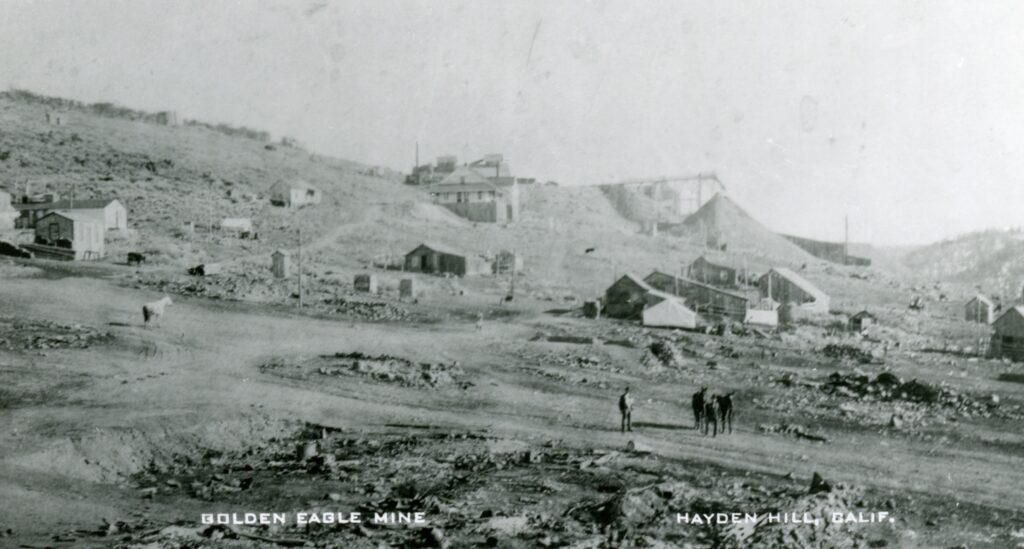
Hayden Hill, located some fifty-five miles north of Susanville, was Lassen County’s largest mining community. Unlike its counterparts in California and Nevada, it was small in comparison. Like so many mining communities, Hayden Hill went through numerous boom and bust cycles.
Of course, in 1870 when word spread of the gold discovery miners flocked hoping to find a new “Comstock.” By the mid-1870s things had fizzled on the “Hill” as locals referred to it. In 1878, several major discoveries and the prospectors returned. For the next eight years it was Hayden Hill’s most prosperous times. It was followed by a downturn, then brief uptick, and continued that way. By 1909, Hayden Hill witnessed prosperity that it had not seen since the late 1870s. In 1910, a devastating fire wiped out a major portion of the town and it never fully recovered.

When Lassen Gold Mining revived operations during the early 1990s at Hayden Hill, the miners and their families did not reside there, many opting for Adin the nearest community. When Lassen Gold shut down in 1997, the open pit operation scared the landscape forever and its such a mess the entire “hill’ is fenced off.
Support
Because arsenic is used to extract the gold. black plastic is used to build holding ponds for the waste water. How long is this plastic going to hold in the deadly waste?
Cyanide, not arsenic was used to extract the gold and silver. Cyanide is a carbon-nitrogen compound, it quickly degrades.
Cyanide is incredibly toxic and does not breakdown quickly.
https://en.wikipedia.org/wiki/Cyanide
The liner systems at Hayden Hill are high-density polyethylene (HDPE) in different thicknesses depending on the facility. The liner systems provide for reduction of hydrostatic head against the liner as well as leak detection elements. HDPE has an extremely low coefficient of permeability as well as carbon black to preclude degradation from ultraviolet light. In their reclaimed state, the liner is buried beneath heap leached ores, detoxified tailings, and topsoil/growth media. With no UV intrusion the liners are expected to last hundreds of years. It is not known how long an HDPE liner will last given liners installed in the 1970s are still functioning. Protection from physical impact and UV light suggest extreme longevity.
Solutions containing sodium cyanide are easily detoxified through chemical means (e.g. hypochlorites, INCO process, etc) and exposure to light (UV, etc). While NaCN is indeed highly toxic, through proper handling practices and detoxification techniques, it is safely used as a luxuriant in precious metals processing and recovery.
It appears both the tailings facility and heap leach pad have been successfully closed and reclaimed. Reclamation desired plant communities appear to be established and functioning on the reclaimed surfaces of the facilities.