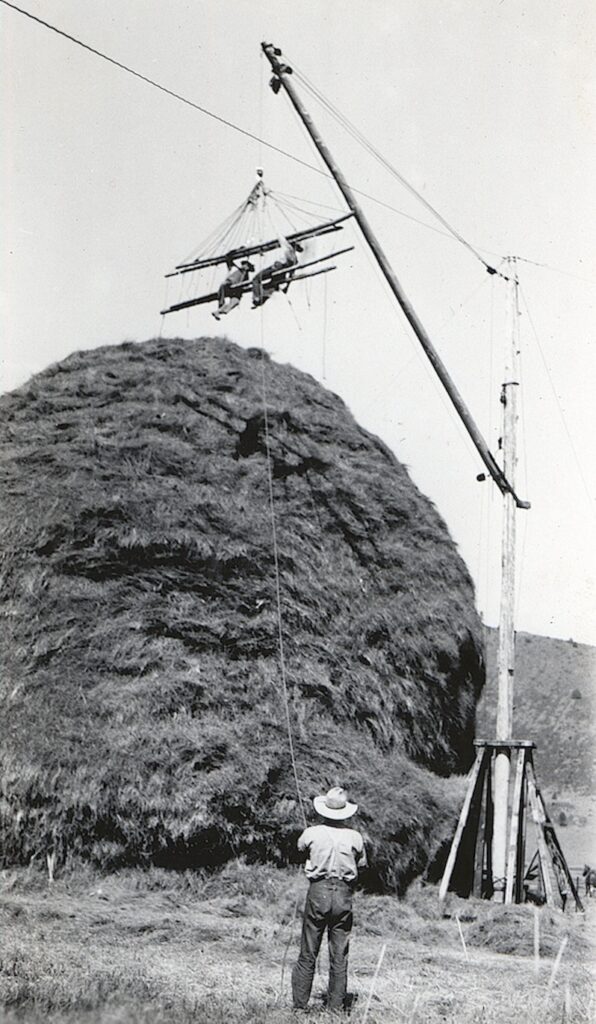
Linda Hartwig had a few questions of hay derricks. She stated her family homesteaded in Klamath county starting in 1892. She wants to write up some of the family stories for a children’s series and wants to be accurate about the process. For a refresher see my post about the topic here.
Linda wrote: “I have a picture from the family archives of a hay stack being built with a hay derrick and what looks like a hay net. It is rounded on the bottom and is a huge ball of hay, so doesn’t look like it could be a Jackson fork. I need enough information on how it was released so the hay could fall onto the stack.”
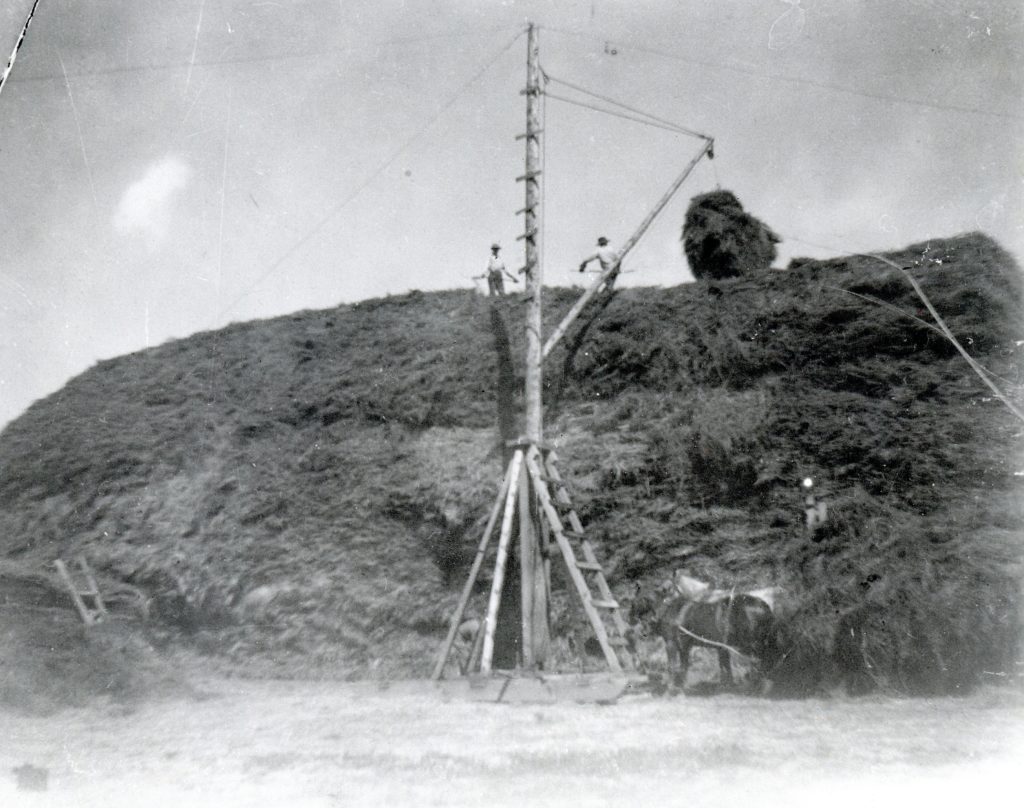
There were usually two men on the hay stack and their job was to evenly distribute the hay, once the hay net was released. There was a man on the ground, who had control via ropes and pulleys to release the hay. An interesting process indeed. As a matter of fact in 1939, the entire operations of the Vic Christensen ranch near Likely (Modoc County) was filmed, and I believe it had short clip of the hay derricks in use. The film named The Cattleman, was done in part of Encyclopedia Britannica’s educational films of the era. I have it onVHS tape. I did have it converted to a CD. However, I lent the CD to some one, and they never returned it.

After World War II there tremendous advances in motorized hay mowing machinery and baling of hay. In the early 1960s, the Bill Brothers of the Standish district were the last to do mowing of hay with horses and to use hay derricks.
If anyone has additional information about hay derricks in general, you are more than welcome to enlighten us.
Tim
Most interesting. In the late 1940s (after WWII) when I was 8-9, I and neighbor kids we “hired” to fork cut hay into a baler pulled by mule. The next day we stacked bales on trailer pulled by same mule. We quickly learned the art of using hay hooks and knees to lift bales. We weren’t very big so leverage was our friend. This was in Ventura County. Today, somebody would have gone to jail for exploiting cild labor. We were happy to be able to buy our own Levi’s and Penny candy.
Thank you, this is great, and the pictures are wonderful. I’m still not sure how the man from the ground released the hay. There must be some sort of trip mechanism, or maybe by him yanking down in the center, that forced the hooks apart. From this picture I found on the internet, it looks like they must have had several of the nets. I found this picture on the internet:
https://haytrolleyheaven.com/wp-content/uploads/hay-slings.jpg
In ‘62/63 “ bucked hay” for the Bill Brothers !!
That had just converted to bails, but the entire ranch was a horse operation !!!
Charley , with his whip , could knock a fly off one of the team’s horses without touching the horse!!
The only gas motor on the ranch was a conveyor motor- only used to “ top out “ the barn!! We stayed in the bunk house, worked sun up to sun down!! &10.00 a day plus she fed us. Charlie was a Good , Honest, Hard working man!!
My sister and I grew up in Sand Hollow, Idaho, a little east of new Plymouth… We had hey Derek’s and at that point, we’re no longer in use, but became the absolute best tire swings!!