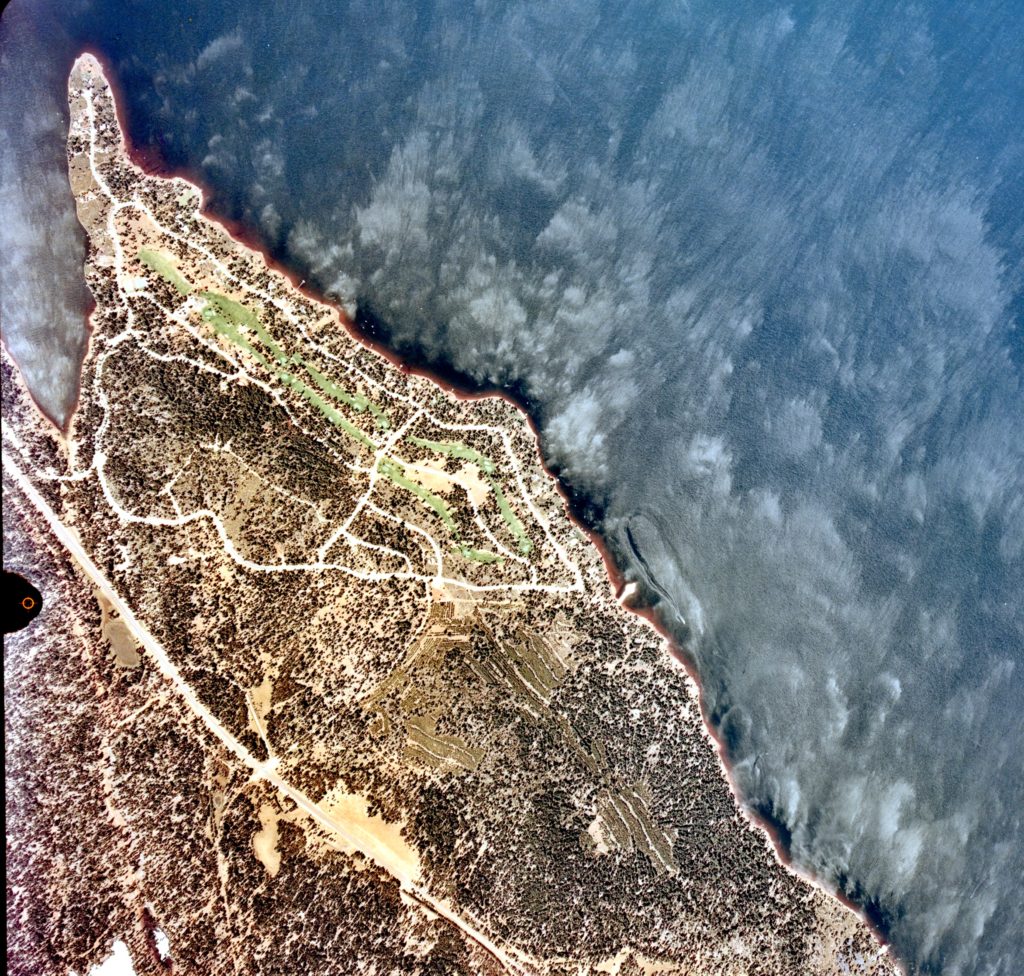
In 1950, Ed Clifford and others purchased large tracts of lakeshore property at Lake Almanor from the Red River Lumber Company. They initially focused on the Lake Almanor Peninsula that later evolved into the Lake Almanor Country Club. Thus, the one tract they owned on the west shore of Lake Almanor remained idled. That changed in the early 1970s with the proposed development of Lake Almanor West. In 1974 the first lots were placed on the market of the 615 acre subdivision.
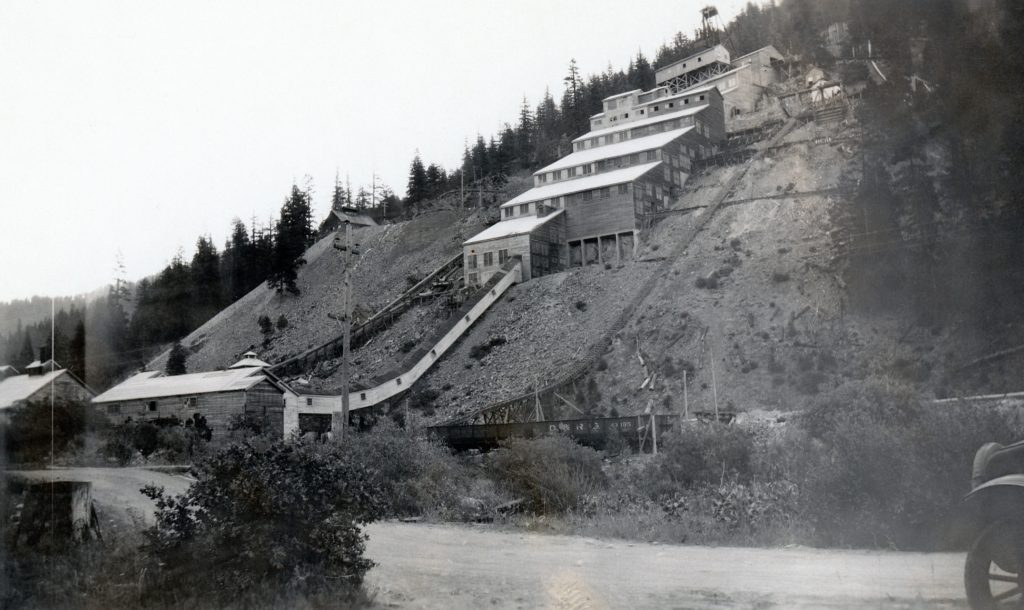
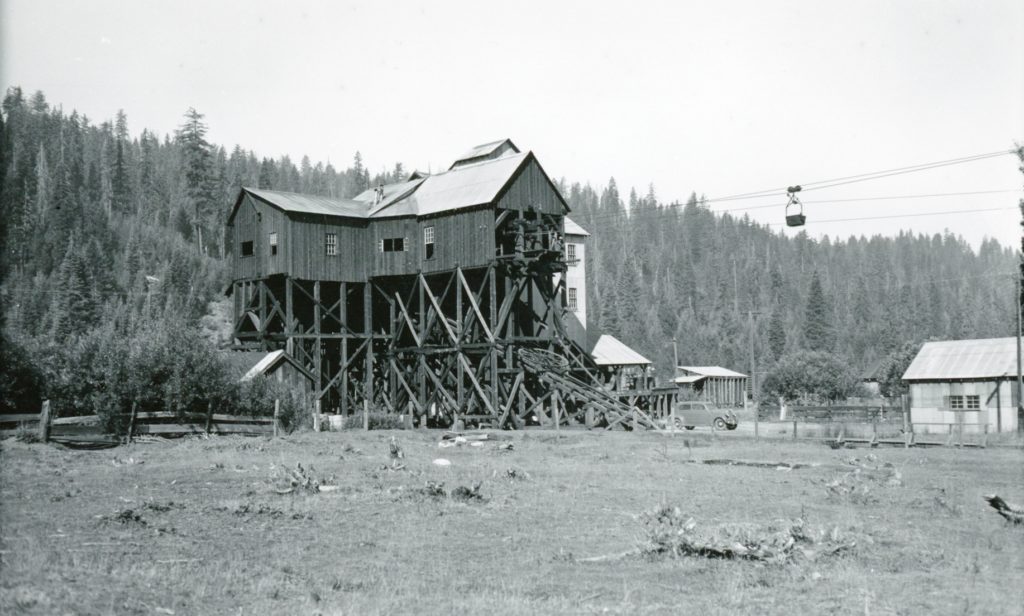
Engels Copper Mine, 1922. Courtesy of Lola L. Tanner
The shortest way from Susanville to Engels Copper Mine is via Gold Run, though not advisable if your are not familiar with the territory. In 1880 Henry Engels discovered copper at Lights Creek near Taylorsville, it being a part of the Plumas Copper Belt.
Major development of the mine occurred in the 1910s. For a time it was the largest producer of copper in California. At its peak in the early 1920s, the townsite of Engelmine boasted a population of 1,200. While the mine closed in 1930s, the remnants that still remain are worth a visit.
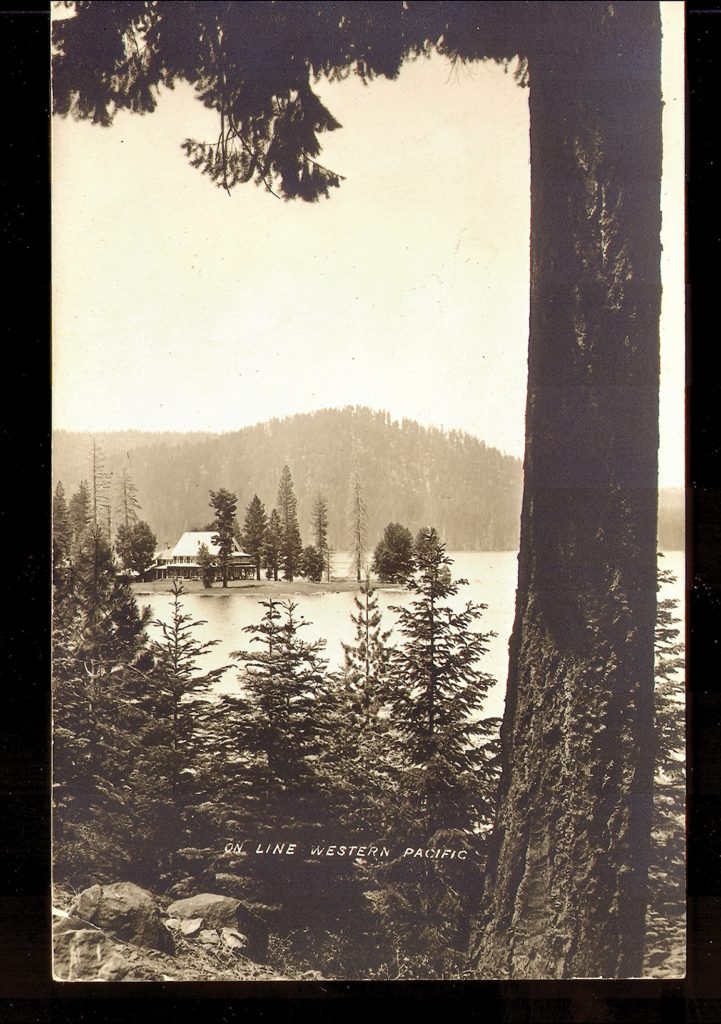
Nevis Island, 1914 – Courtesy of the Plumas County Museum
This was a short-lived man made island during the creation of Lake Almanor, it received its name from dam so named that created the lake. It was located at the southern portion of Big Meadows, prior to the creation of Lake Almanor. It should be duly noted, that in the late 1800s, the region consisted of dairies, ranches and summer resorts. After all, one has to remember this was back in the day when there was no such thing as air conditioning and those who could afford to escape the heat of the Sacramento Valley in the summer flocked to the cooler mountain regions.
Prior to becoming “Nevis Island” it started as a resort known as Meadow View established in 1882 by A.R and Clara Bidwell. It was an investment for Bidwell, and the hotel was leased. In 1902, it was acquired by Great Western Power Company who subsequently closed the hotel. For a brief time in came back to life, and in 1909, Great Western made improvements to the building and it became their local headquarters. In the fall of 1913, Great Western closed it down. Due to an unusually heavy precipitation in January 1914, the new reservoir, later to be named Lake Almanor, began filling up unexpectedly and thus created Nevis Island for a brief time, until was finally submerged.
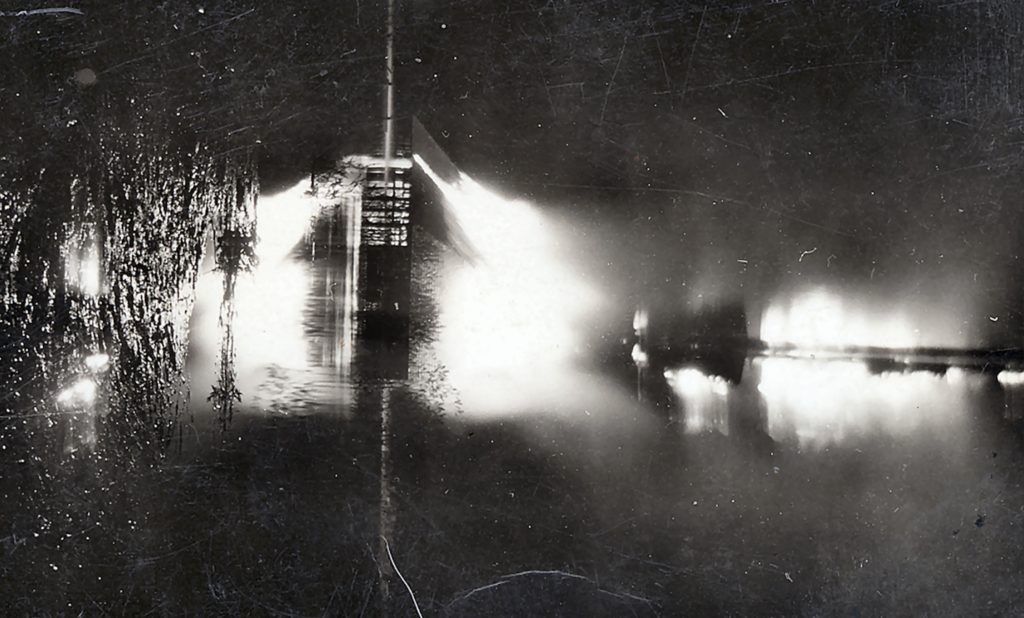
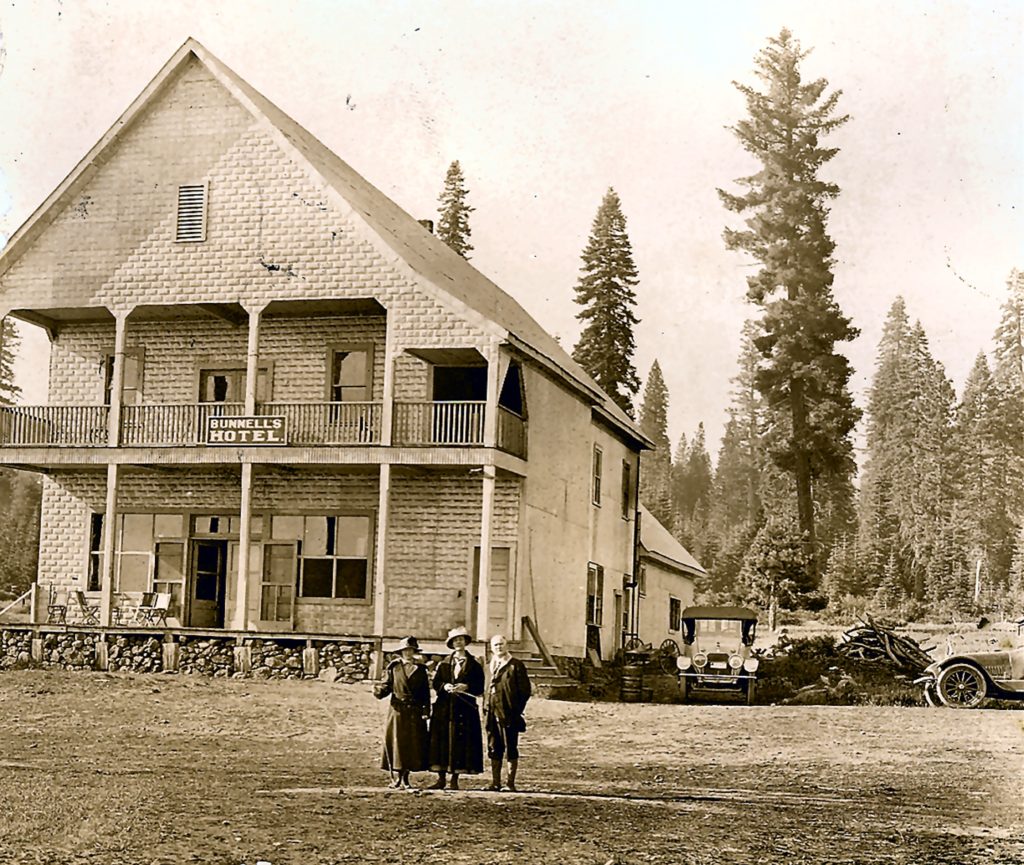
June 6, 1914 burning of Bunnell’s-Courtesy of Holly Blackburn
In 1867, Luther Wellington “Wells” Bunnell relocated from Butt Valley in Plumas to nearby Big Meadows, known today as Lake Almanor. One of his distant neighbors was Dr. Willard Pratt, who opened the first hotel in Big Meadows which was met with great success. After all, those who could escape ever so briefly in the summer months from the Sacramento Valley, flocked to places like Big Meadows to escape the heat, after all this pre-air conditioner times.
For thirty-eight years Bunnells became a well known resort. Changes were on the horizon, especially with the Great Western Power Company who had entered the picture in 1901 with plans to transform Big Meadows into a massive reservoir as part of its hydroelectric power system. On April 11, 1906, Bunnell entered into an agreement to sell his place for to Great Western Power for $35,000. He moved to Susanville the following year and for a brief time the power company used the resort, now closed to the public as their headquarters. With the dam nearing completion and the flooding of Big Meadows to become a reality, on the evening of June 6, 1914 all the buildings at Bunnells were set ablaze for demolition.
The ‘annex” at Bunnell’s – Courtesy of Holly Blackburn
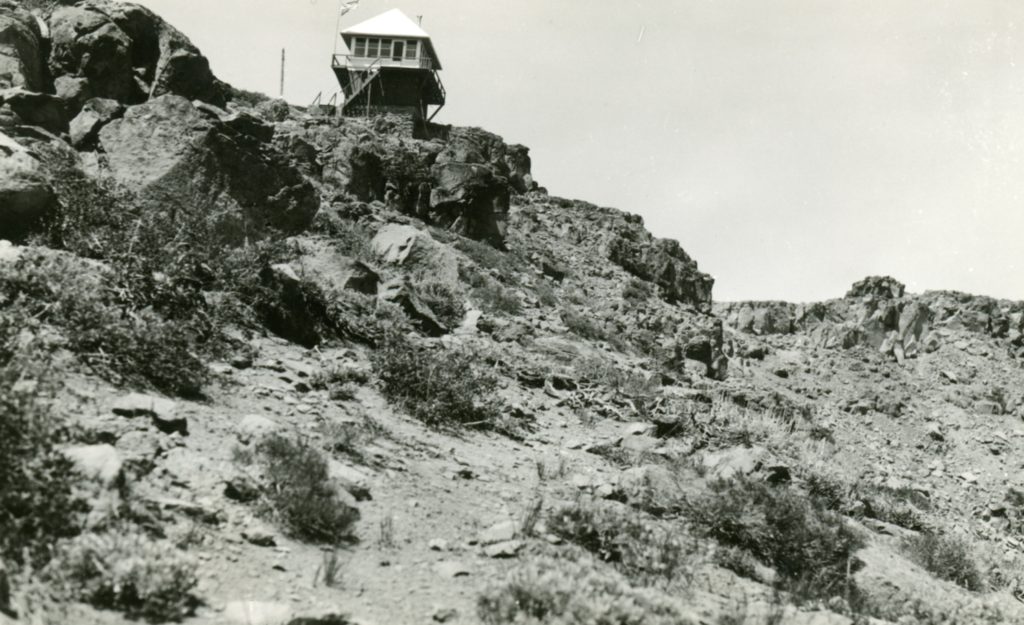
Thompson Peak Fire Lookout, circa 1950–Courtesy of Margaret Purdy
September is a wonderful time to go out and explore, with mild temperatures and in many cases most of the back roads you will have all to yourself. An interesting excursion is the Thompson Peak Fire Lookout that looms above Janesville at an elevation of 7795’. It was built in 1931, and it is still a manned lookout. The view of the Honey Lake Valley and the surrounding territory is magnificent. However, due to the Walker fire it may be awhile before one can access Thompson Peak.
Walker Mine was located in almost the geographical center of Plumas County, part of the regions copper mining belt. There is no connection with the Walkers of the Red River Lumber Company and the mine. In 1909, J.R. Walker, G.L. Bemis and A.H. Bemis filed on the mine site, but did not start development until 1911. It would eventually become a thriving community with over 500 men on the payroll. The good times did not last that long, and in 1942 the mine shut down. Today, not much remains there.
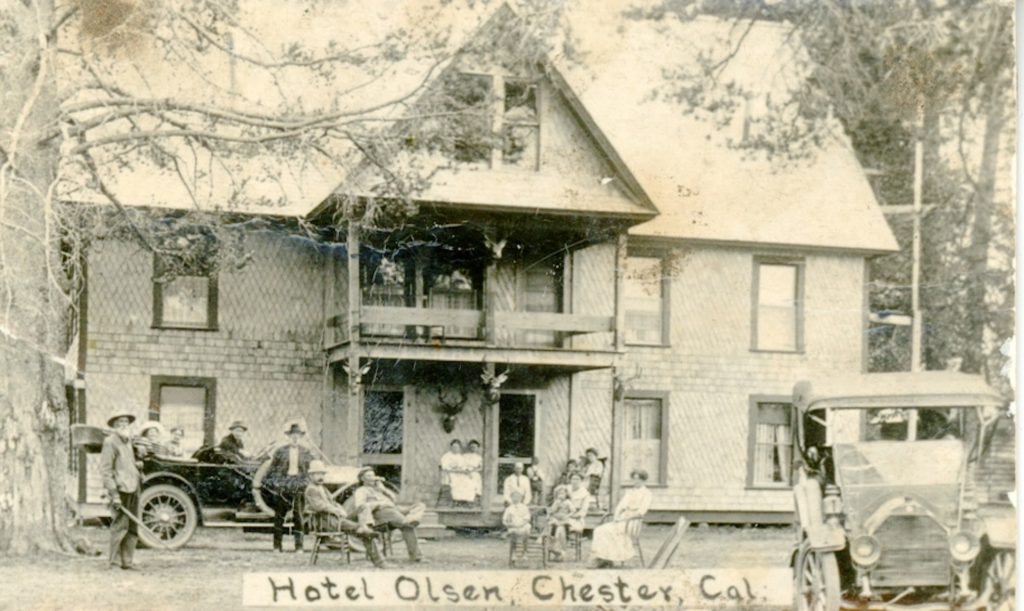
Hotel Olsen, Chester. Courtesy of Margaret A. Purdy
Peter Olsen was one of the early settlers of Big Meadows, known today as Lake Almanor. Like so many of the residents there of the late 1800s, he operated a dairy among other pursuits. By 1885, his ranch located in the proximity of modern day Chester consisted of 1,300 acres, one of the largest in Big Meadows.
In the early 1900s, the Great Western Power Company began acquisition of the ranches in Big Meadows, with their intention to create a reservoir, a part of their hydroelectric power system. The Olsen family sold nearly a 1,000 acres of the ranch, retaining a small acreage surrounding the ranch house. In the fall of 1911, Olsens, along with their neighbor, Edith Martin subdivided their respective properties to create the town of Chester. Olsen’s Southern Addition consisted of twelve blocks containing 115 lots. In 1914, the Olsen’s built a major addition to their ranch house and now became the proprietors of the Hotel Olsen, a first for that community. Nels and Eula Olsen operated it for many years and on April 4, 1948 they sold the hotel and the remaining Olsen Ranch to Earl McKenzie and the hotel was subsequently closed.
Chilcoot Tunnel, December 2, 1906. Courtesy of Marge Foster
In the fall of 1903, Western Pacific Railroad surveyors invaded the Honey Lake Valley and the region west of Susanville. This led to speculations regarding a new route to bypass Beckwourth Pass. If that was the case, the railroad would not have to build the 6,002 foot-long Chilcoot Tunnel under Beckwourth Pass, but even an additional longer tunnel at Spring Garden towards Quincy. It was decided on the Beckwourth Pass route, though the Susanville route would later gain traction.
On May 28, 1912, a fire broke out on the west end of the Chilcoot Tunnel. The heat was so intense WP crews were unable to suppress it. Newspapers, both local and regional, were quick to attack the WP over the costly Chilcoot and Spring Garden tunnels. It would take nearly a year before the Chilcoot tunnel could be repaired. To keep the trains moving, an expensive shoo-fly (temporary track) was constructed over Beckwourth Pass.
The Susanville route, now referred to as “cut-off” was debated. On September 13, 1912, Susanville’s Lassen Advocate wrote: “The Chilcoot Tunnel is still too hot that men cannot work in it. That tunnel will yet make it so hot for the pocketbooks of the Western Pacific.” It took nearly a year and a half before the tunnel reopened.
Chester, California, 1914. Courtesy of Dolores Gasperoni
By 1911, there was no doubt in anyone’s mind that shortly the Great Western Power Company would transform what was known as Big Meadows into Lake Almanor. The area had been undergoing a major transformation when the power company purchased many of the ranches and resorts that would be submerged once the dam was built.
At the northern end of Big Meadows, the Olsen family were on the fringe and while they sold the majority of their ranch to Great Western they still retained the property around their home. Their neighbor, Edith Martin had witnessed a large amount of campers at her place with the demise of the town of Prattville. In August 1911 Edith Martin and the Olsens hired Everett M. Cameron to survey and subdivide their respective properties, thus officially forming the town of Chester.