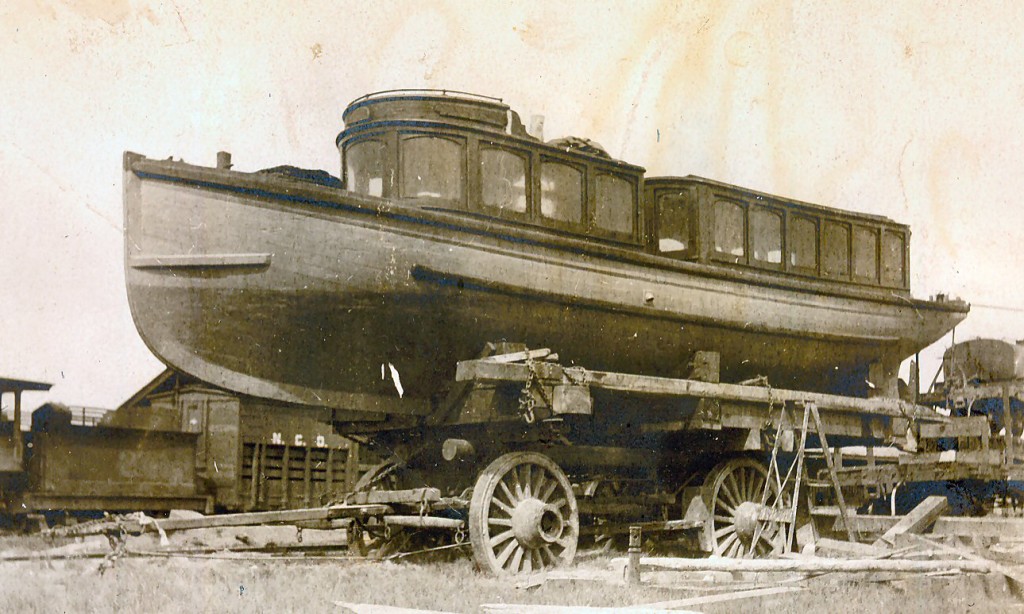
Lassen Mill & Lumber Company’s tugboat at Amedee, just before launching on Honey Lake, 1907. Courtesy of Marie Herring Gould
Well, it seems only fitting on the eve of the first anniversary of this web site, that a book of the month is featured. After all proceeds from book sales not only help support operations, but help finance future publications.
Sagebrush Reflections: The History of Amedee & Honey Lake my first book which made its debut back way back when in 1983, is remarkably still in print, barely. There were two boxes tucked away storage, but now down to one box, so about 60 copies are still available. This is the only concise work on the infamous Nevada-California-Oregon Railroad boomtown of Amedee located on the east shore of Honey Lake, but all the trappings of Honey Lake. A lot of things happened on Honey Lake, whether it contained water or not. So for a mere $12.00 you can buy this classic, before it goes out of print, and on Bookfinder.com they have a used copies for sale with price ranging from $20 to $3,000.
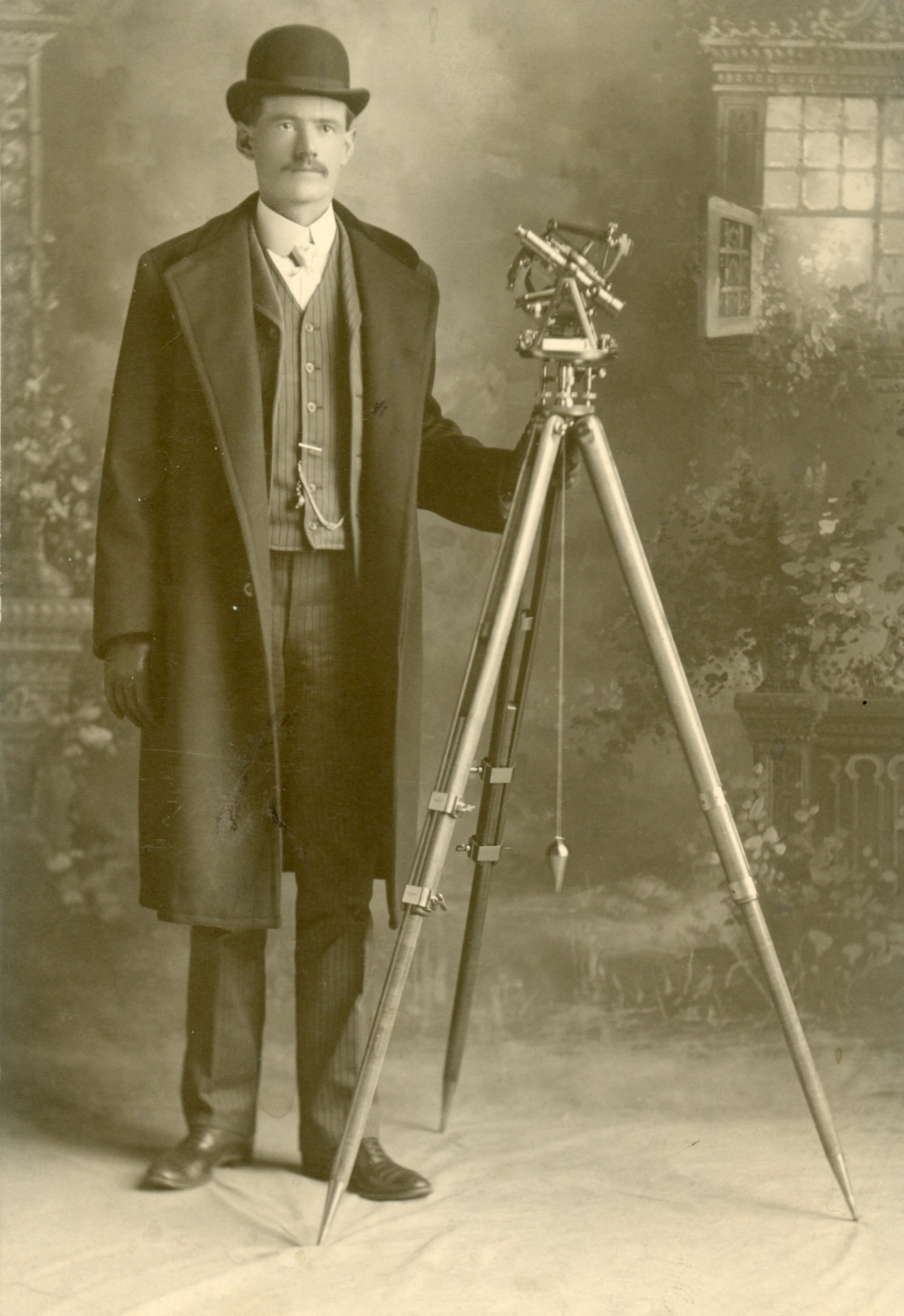
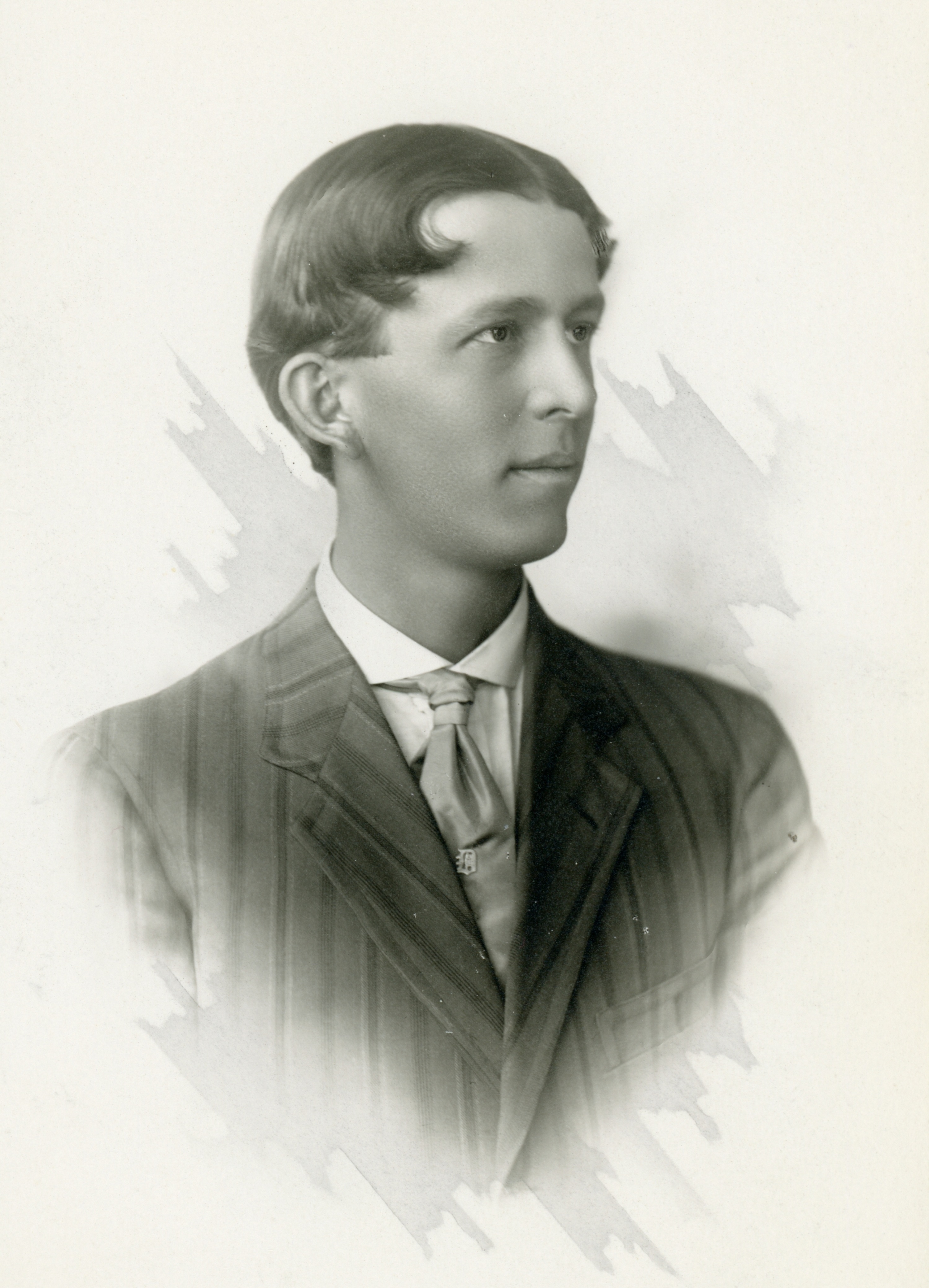
Personally, this east side Honey Lake Valley resident, is a fascinating figure and I relate to him in on many levels. He began his career first working for U.S.G.S. He did extensive travel in the western United States with that agency. In 1905, he was part of the survey team to survey the boundaries of Crater Lake National Park. He put together four albums of his work there, with detailed notes.* During this same time, his brother, Marvin, was lured to the sagebrush plain of eastern Honey Lake Valley, and took up a homestead that would later become the nucleus of the town of Stacy.
In time, Marvin convinced Carl to join him the reclamation enterprise there. Their first endeavor was a well-drilling business, since the new homesteaders arriving in the region would need wells for domestic purposes. Carl kept well logs, that information nearly a century is an important resource. In addition, he monitored the flow of High Rock Springs to see how the wells affected its flows.
The big project in the region was the establishment of the Standish Water Company and their intent to build a pumping plant to use the water of Honey Lake to reclaim the sagebrush lands. The company recruited Carl, as its engineer. Not only, did Carl oblige, he and his brother invested $20,000 towards the project. The project went bust, see Standish Water Company posts for details.
The one bright side, during these bleak times, was they had a great well, that not only provided their domestic needs, but irrigation, too. The family carried on. During the height of the homestead era, Carl was busy as a surveyor to plot out each land claim. By 1920, the area was deserted and services as a engineer or surveyor were no longer needed. Nevertheless, Carl persevered. In the 1930s, the United States Army contacted Caudle for information on this portion of the Honey Lake Valley. Caudle’s knowledge not only paid off for him, but for the region as a whole. It was with his information and lobbying efforts that the government established the Sierra Army Depot in 1942. He never saw its complete development, or that of the community of Herlong for he died in his sleep at his Stacy home on August 4, 1942. He is buried in the nearby Honey Lake Cemetery, with other family members.
*The albums have been donated to Crater Lake National Park.
It was an ice skating accident which resulted in the last drowning in Honey Lake. On January 24, 1915, a skating party was held on the northwest shore with approximately 175 people in attendance. Continue reading A Honey Lake Drowning→
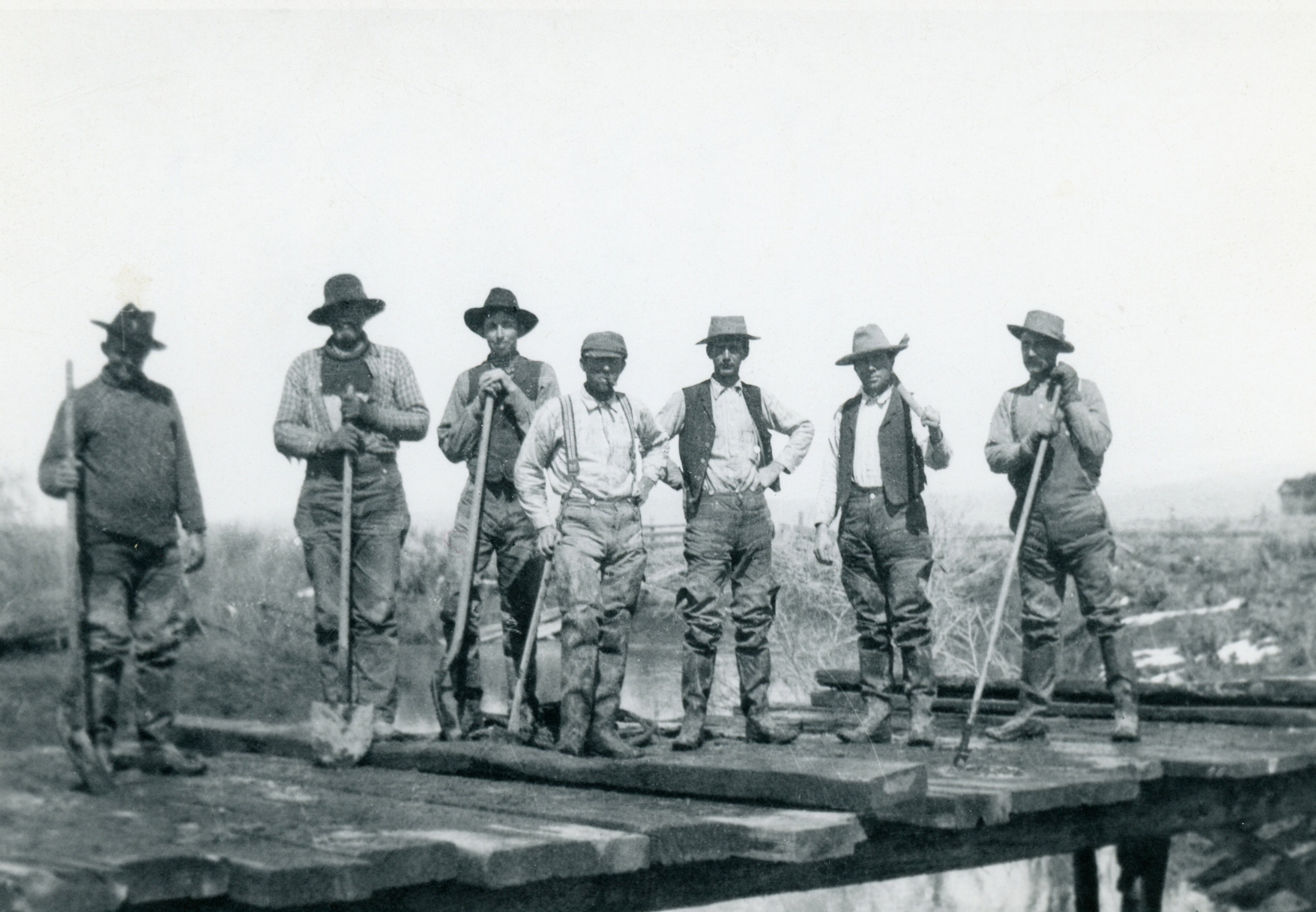
The annual chore of cleaning the slough. Left to Right: George Hartson, Curtis Winslow, Colin Whitehead, Mr. Zumwalt, Will Hartson, John Theodore, Will Spoon. Courtesy of John H. Theodore
Once Susan River flows past Standish, it starts breaking into various sloughs before it reaches Honey Lake. Some of these sloughs are natural, and some man made.
The Hartson Slough is man made, named after Charles Hartson. In 1881, Hartson filed on 160 acres of sagebrush land near Honey Lake, in the Tule District. However, Hartson needed more water to not only reclaim this parcel but to expand. In 1889, Hartson worked as the construction superintendent of the Ward Lakes Reservoir. Hartson made a deal with the Balls Canyon Reservoir Company, the company behind the project, that, for a portion of his services, they would give him a share of water rights to Willow Creek. This gave Hartson the water he sought to reclaim his land. He built the slough to convey the water to his ranch. By 1901, Hartson owned 1,500 acres of land, half of which was planted in alfalfa. In that same year, Hartson & Sons ranch was one of the first in Lassen County to incorporate. In 1910, Charles Hartson retired and moved to Susanville. He turned the ranch over to his son, Frank Hartson.
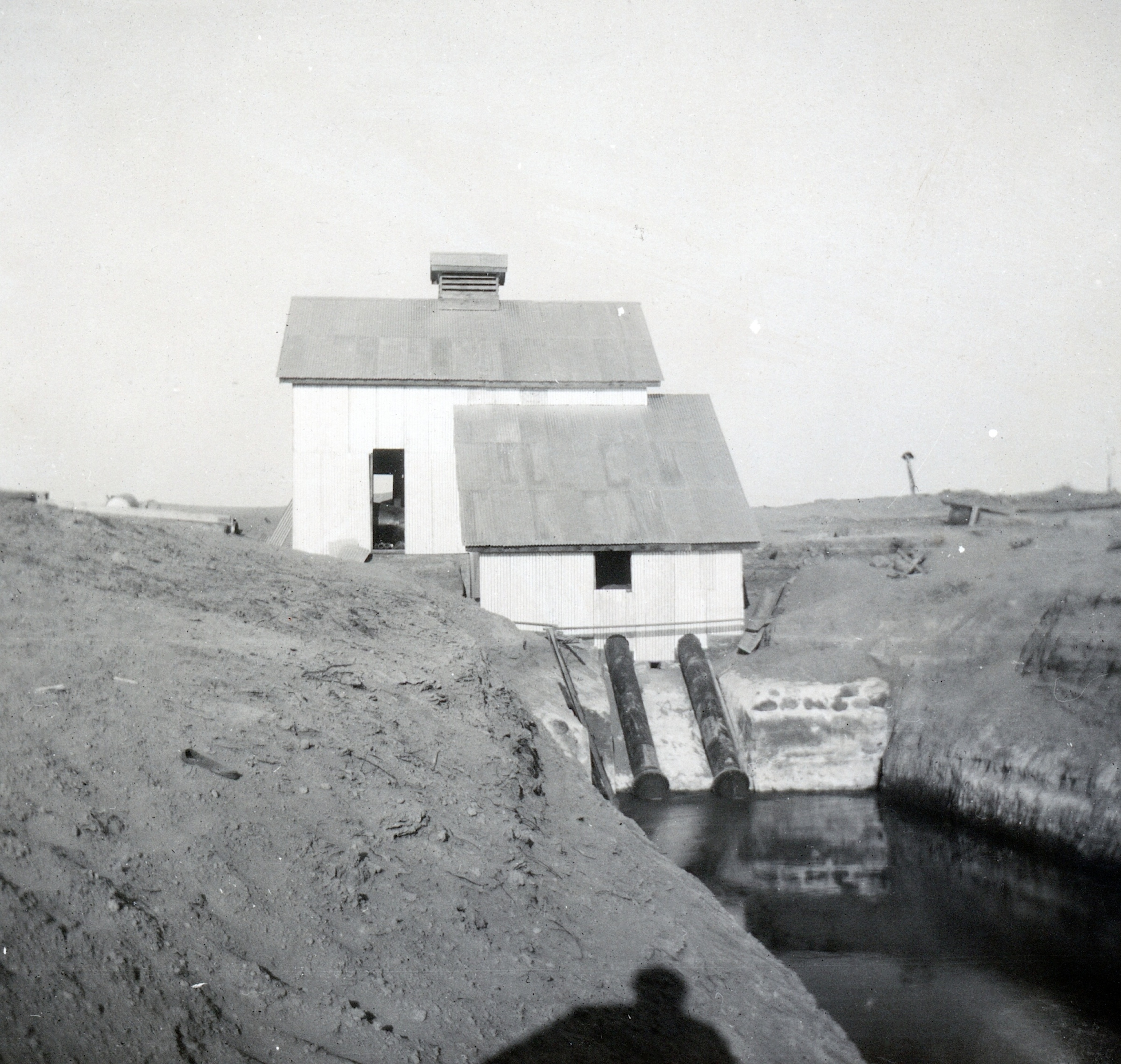
Standish Water Company’s pumping plant. C.R. Caudle collection
When Honey Lake is full it is an impressive body of water. There have been those over the years who thought it could be put towards a beneficial use. In 1878, Captain Charles Merrill came up with the first proposal to use water from the lake to irrigate the sagebrush lands on the lake’s eastern shore. Others, too, looked at lake’s potential for irrigation, but nothing materialized.
In the Standish district, two families who were joined by marriage—Hartson and Holmes—made plans to utilize the lake’s water for irrigation. In 1909, they formed the Standish Water Company. The Company was successful in attracting investors, one of whom was Carl Caudle. Caudle was a civil engineer, who had a homestead at Stacy on the east side of Honey Lake. Not only was Caudle instrumental in designing the project, he also invested $22,000.
In April 1910, construction began on a pumping plant on the east shore of Honey Lake, about two miles south of Amedee. A 150 horsepower Fairbanks Morse engine with a 24-inch centrifugal pump powered the pump house. Eleven miles of canals were constructed in an effort to irrigate 4,000 acres.
On October 4, 1910, on one of those beautiful falls days the region is noted for, set the mood for the inauguration of the pumping plant. During the morning people began arriving from around the Honey Lake Valley to partake in the festivities. Of course, the customary local dignitaries were on hand to provide their accolades. Shortly after noon, the visitors were instructed to assemble along the banks of the main canal to anxiously watch awaited event of pumping water into the main canal. At one o’clock the whistle blew from the engine house, and within moments water burst through the pipes to fill the canal.
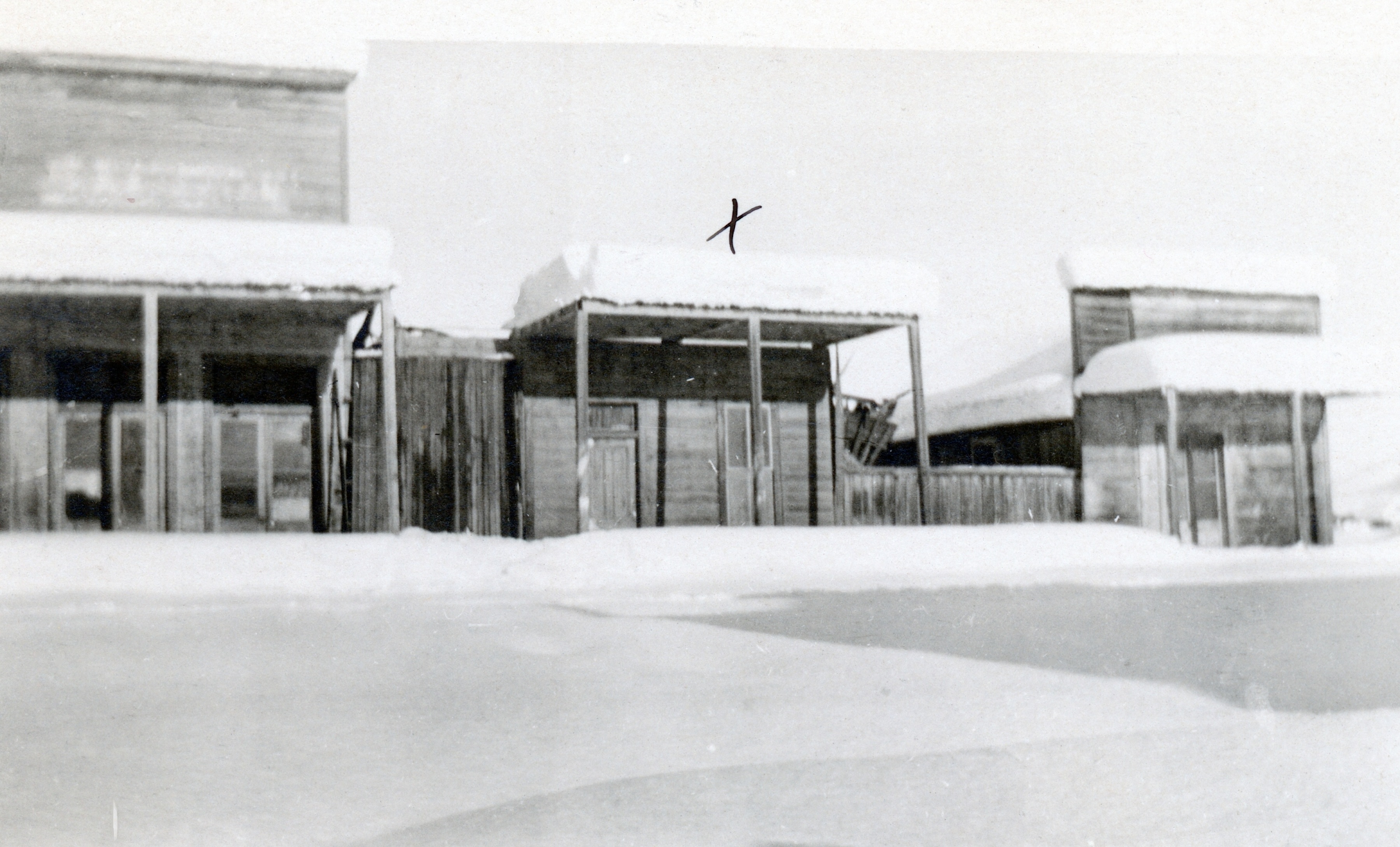
On the surface it appeared the Company was off to a successful start. In addition, Mother Nature contributed to their efforts, when a snowstorm in January 1911 dumped eight feet of snow there! Actually, the weather gods for the next several years were very kind to the east shore residents by providing higher than normal precipitation.
In the Company’s first year 1,000 acres had been planted with sugar beets, with a successful harvest. The following year was a success, too. This changed in 1913, in one of those bureaucratic snafus. The Standish Water Company sold water to individuals who were homesteading on federal lands. Once those individuals met the government’s requirements they could acquire the land for a nominal fee. Disputes occurred, usually from neighbors. In this particular instant, Thomas Philbin contested John Ramsey’s request for a final proof for his 160 acre homestead. The United States Government Land Office (GLO) investigated Philbin’s claim, which they dismissed. However, when it was learned Ramsey’s source of water supply was Honey Lake, it raised a concern.
Amedee, January, 1911. The “x” indicates the town’s old dance hall. Courtesy of Madelyn Mapes Dahlstrom
While a few days ago we examined the winter of 1861-62, there are winters where one storm defines it. These are usually record breaking snowfalls, which nearly all the winter season’s precipitation is received. Continue reading The big snow of 1911→
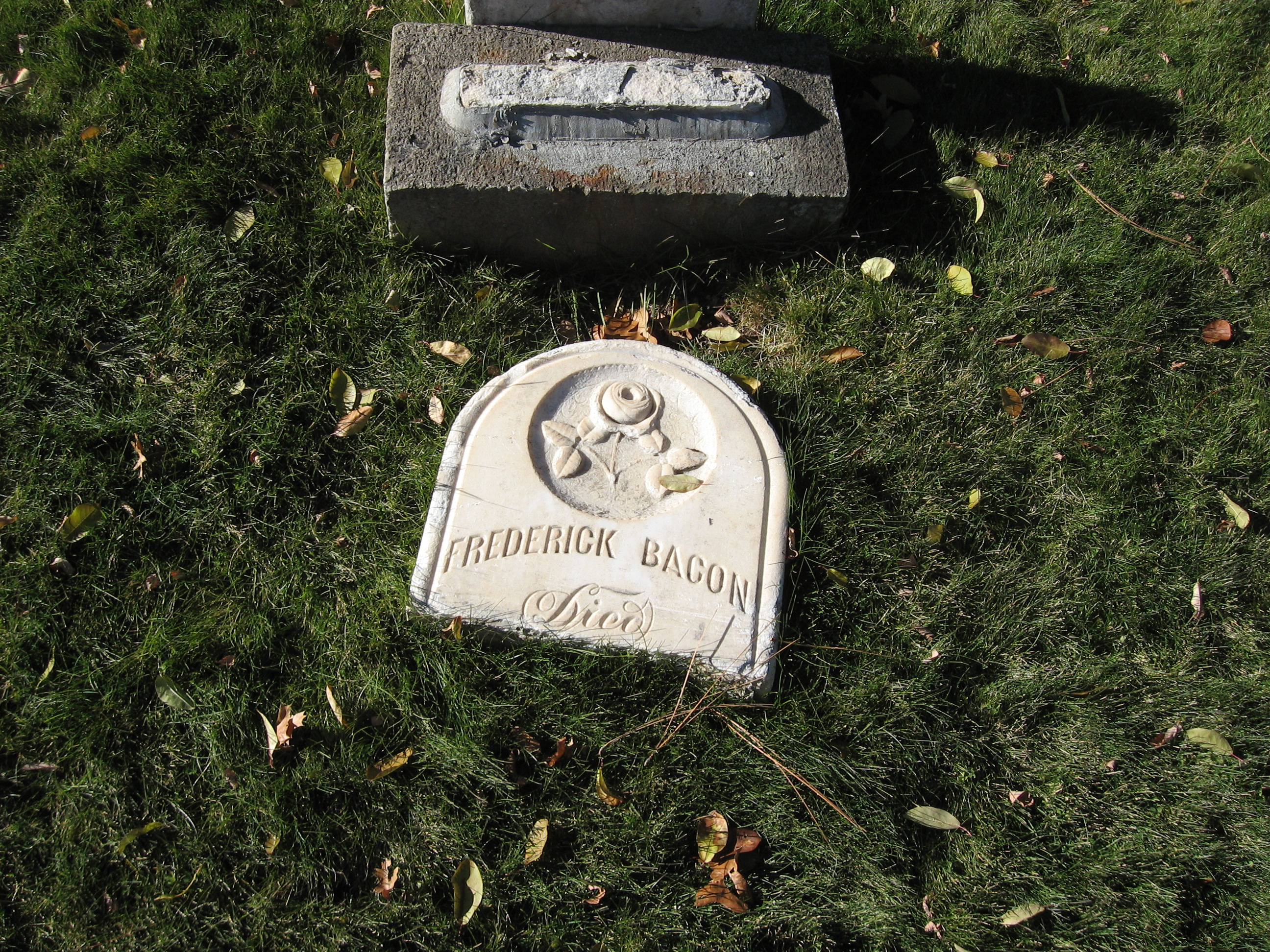
The vandalized headstone of Frederick Bacon, father of W.T. Bacon, Susanville Cemetery. November 21, 2015
Since I had been writing a lot lately about the High Rock Ranch and Springs, I could not resist to pass along the following story. On September 16, 1883 the Susanville correspondent to the Reno Evening Gazette passed along this bit of news:
“That Susanville possesses many advantages, no one who has visited this pretty town will deny. Among those advantages, are the facility with which business is executed here, especially in the line of divorce and matrimony. To illustrate the above, I cite a case that came off here last Friday in the Superior Court. Until that day, one W.T. Bacon was possessed of a wife who had borne him two children, the youngest being a few months old. His residence was at a place called High Rock. Sometime last February, a little unpleasantness occurred which W.T. Bacon did not relish. It seems one J.B. Roberts, being smitten with the female side of Bacon, being qualified, committed adultery with the male Bacon’s wife. Last Friday W.T. Bacon applied for a divorce from his wife, on the grounds of adultery. The woman waived all forms of law, and went to trial immediately. The man—Roberts—came forward and swore to the fact committing the adultery, and the divorce was immediately granted in the afternoon. In the evening between 7 and 8 o’clock, J.B. Roberts and Mrs. Harriet Bacon were united in marriage, the ex-husband being present at the ceremony, keeping the baby quiet during the exercises. Taking it as a whole, it was the largest Bacon transaction here during the week, and causes considerable comment on change.”
Long after the excitement of the gold rush, people were still lured to California. Numerous reports published back east extolled the health benefits of the golden state’s climate. In the spring of 1874, Iowa resident Sylvester Daniels ventured to the Honey Lake Valley to visit his sister, Polly Parks, and see if the change in climate might be beneficial to him. Like many in that era, Sylvester kept a journal. His journals were different in the sense, as he kept a record of his experiences so he could send them back to his fifteen-year-old daughter, Viroqua. Continue reading Sylvester Daniels→
High Rock Ranch, circa 1910. Courtesy of Madelyn Mapes Dahlstrom
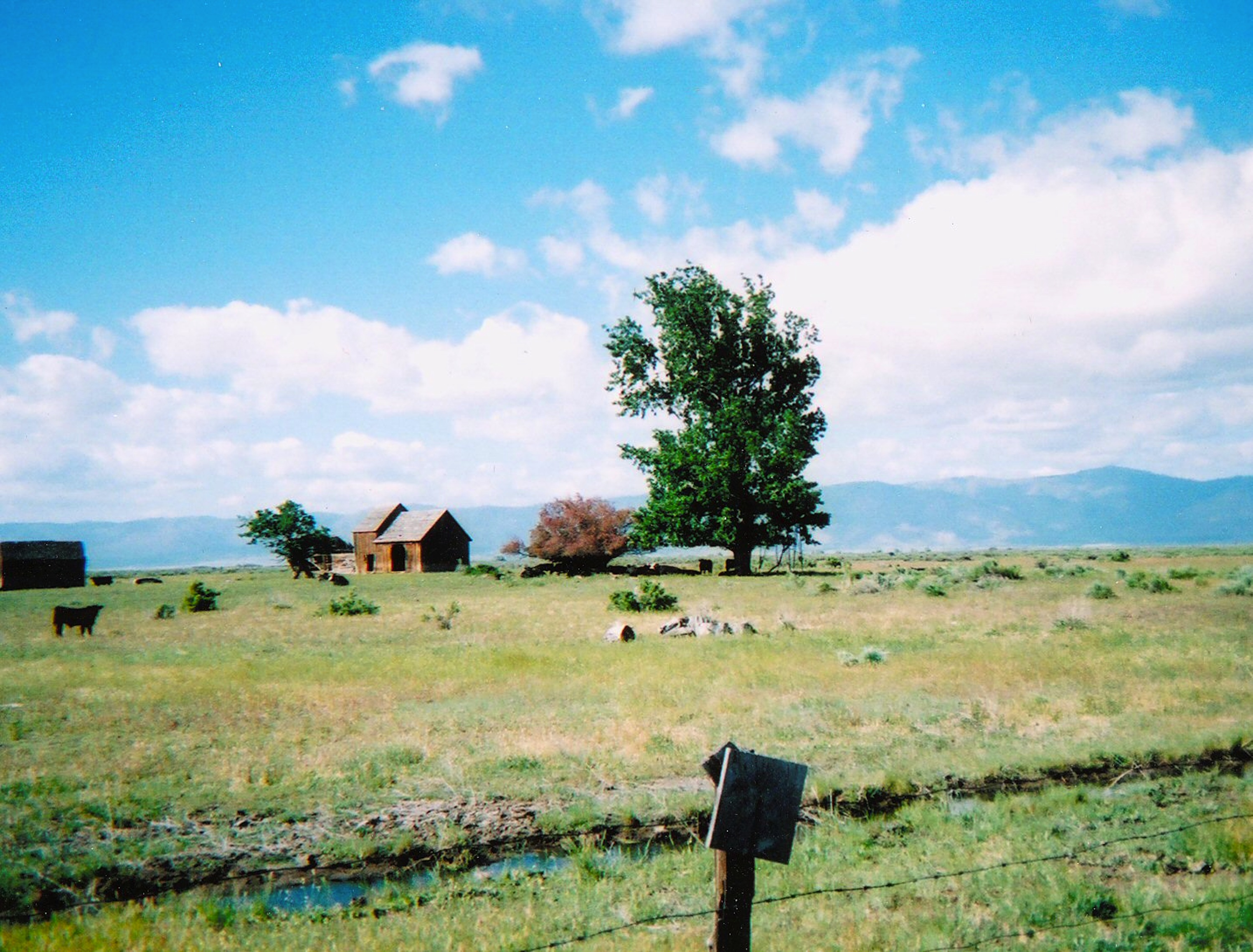
The High Rock Ranch in eastern Honey Lake adjoining the Nevada state line, owes a lot of its existence to the springs. Water in the desert makes a big difference.
Interesting enough, on February 7, 1862, U. Johnson Tutt laid claim to this remote outpost. Tutt made no improvements and abandoned his claim. In the late 1860s and 1870s, High Rock was a scene of rodeos, not quite the same as our modern day version. During this era, very few ranches had fences. It was customary, especially in the winter months to let their cattle and horses roam in search of feed. Each spring several localities were chosen for sites for round-ups and rodeos, and High Rock was one. Once the stray livestock were herded to a specific location, they were separated and branded. Continue reading High Rock Ranch→
In 1859 residents of the Honey Lake Valley experienced one of the most dreaded winter weather conditions, a pogonip—the Indians term for an ice fog. The term loosely translates into “white death,” for many Indians caught pneumonia and died. This fog settles in the mountain valleys. One can ascend a few hundred feet above the valley floor, bask in sunny temperatures and overlook a sea of clouds. Pogonips vary in severity. A mild one will consist of persistent endless fog with sub-freezing temperatures. The worst variety is when it turns into a literal ice fog, coating everything. The first day can be spectacular with ice crystal formations on everything. After several successive days of those bone chilling temperatures, it quickly loses its appeal. The pogonip of 1859 was one of severest on record. The heavy cold fog lasted six weeks. So much frost accumulated on the grasses that cattle could not eat it. In addition, since the first settlers had been accustomed to mild winters, very little hay was put up, and a great many cattle starved to death that winter.