Guest registers are unique historical document and they vary, since one size does not fit all. Today, we examine three.
Roop House Register. In 1856, when Isaac Roop established his trading post along the Nobles Emigrant Trail, which would become the foundation of Susanville, he kept a guest book. This allowed emigrants to write freely. Here is an interesting entry: Sunday, August 31, 1856. “Another Sabbath has passed on the swift pinions of Time and we are a week nearer eternity. A few more and we shall have passed smoothly down the stream of life and paid debt of nature. How different then will this far famed Elysian Valley appear! What great and stupendous changes will have taken place? Where now stands Lassen’s log Cabin, a modern pig sty will have been erected and round the sage covered Ranch will be a rail-worn fence, composed of chiefly of piles of brush. Who among this generation will be able to recognize this valley? Echo answers “nary a buggar.”
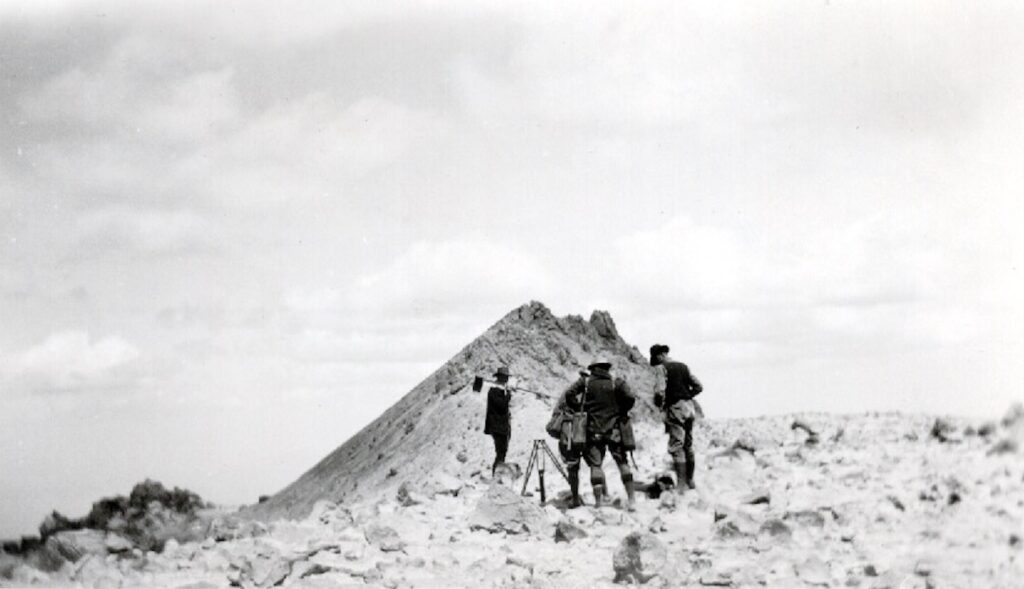
Lassen Peak. In September 1865, Kendall Bumpass guided a party to Mount Lassen at the request of Watson Chalmers, publisher of Red Bluff Independent newspaper. When the Chalmers party scaled the peak, they found a bottle there that was used as an impromptu register. The jar contained various slips of paper left by previous climbers and the Chalmers party added their names to it. Over the years a guest register was placed on the peak for people to memoralize their trek to the summit. Sometimes the register was supplied by the Sierra Club and other times by the Siffords of Drakesbad. Periodically, the park service conducted surveys to see how many people were climbing it. In 1933, for instance, from July 1 to August 18, 24,561 entered the park. Of that number, 3,725 climbed the peak and written their names in the register. Park officials calculated then that 15 of every 100 visitors climbed the lofty peak.
Max’s Mausoleum. This is an obscure site, created during the filming of a major motion picture in the late 1920s. This was common for commercial movies to be filmed here, but that is another story. Max’s was located in a narrow canyon west of Astor Pass, which is between Pyramid Lake and Honey Lake Valley. A small tunnel was carved into the hillside, about seventy-five feet. An alter was installed. After the production ended, a register was placed. It is my understanding the register was removed in the early 1970s and donated to the Nevada Historical Society.
Donate